... To understand what their ups and downs are. Yet another example came to me recently. I was just reading my iPad on my couch, with the iPad on my legs - I didn't hold it at all. Why should I hold it?
So I remembered that discussion I had a few months ago with a colleague about the iPad before I bought it. He said: "that's a cool gear, but it weight quite a lot and must be tiresome to hold a long time, for things like reading". Of course, when you read a pocket book, you have to hold it. It's not a real problem because it's light, but one of the biggest reason you hold the book is to keep it open. But you don't need to keep the iPad open. So holding it is unnecessary. But who would have thought to that without trying?
Thursday, August 18, 2011


Thursday, July 28, 2011
A European Rating Agency?
There has been quite some discussion lately about the supremacy of the US rating agency, and why there should be a European rating agency to counter that. Many politicians over the EU even argued that this agency would rate less aggressively Greece and other countries with debt difficulties.
So let me try to get it straight... A European rating agency wouldn't do much for Greece and similar European countries, where it couldn't pretend the least independence. But it would have already downgraded the US.
This post is building on a tweet from a few days ago.
So let me try to get it straight... A European rating agency wouldn't do much for Greece and similar European countries, where it couldn't pretend the least independence. But it would have already downgraded the US.
This post is building on a tweet from a few days ago.
Sunday, June 19, 2011
Cities should copy the High Line
Recently I came across a few articles related to the new High Line section opening. I already noted to see the High Lane next time I'll be in New York, so I had a look at these articles. Inhabitat has a great article, with video including an interview of the landscape designer. Also the press across the world reported that opening.
I find that very interesting, because... Who would think a refurbished railroad would provoke such much enthusiasm and curiosity across the world? Just because it's in New York? There are many parks in New York and no one mention them outside the city boundaries (Tompkins Square anyone?).
So there must be something else. One is that the design is really modern and ambitious, with very well designed paths, vegetation everywhere, places to socialize. Another one is that it is higher than the rest of the streets, giving a new view on the city - and New York is probably one of the very best places to make use of good perspectives!
Also it is not really a park - it is more a way, making de facto a pedestrian street in New York, which is definitely not common.

(image from Wikipedia)
So in many sights, the high lane is really innovative. So what if others could cities could take inspiration of that? In my town for example, there is a big debate about doing a stair between the river and an former hospital from the middle age, building a whole new path above the historical city wall. I think that is a wonderful idea, as it will create a whole new street in a town quarter that hasn't seen much new streets in the last 500 years.
Creating such attractions also makes people curious, and make them come there. It's not needed to say that many city centers need to attract people back. That won't happen without changing anything. By reusing the existing infrastructure and being creative with it, magic things happen.
I find that very interesting, because... Who would think a refurbished railroad would provoke such much enthusiasm and curiosity across the world? Just because it's in New York? There are many parks in New York and no one mention them outside the city boundaries (Tompkins Square anyone?).
So there must be something else. One is that the design is really modern and ambitious, with very well designed paths, vegetation everywhere, places to socialize. Another one is that it is higher than the rest of the streets, giving a new view on the city - and New York is probably one of the very best places to make use of good perspectives!
Also it is not really a park - it is more a way, making de facto a pedestrian street in New York, which is definitely not common.
(image from Wikipedia)
So in many sights, the high lane is really innovative. So what if others could cities could take inspiration of that? In my town for example, there is a big debate about doing a stair between the river and an former hospital from the middle age, building a whole new path above the historical city wall. I think that is a wonderful idea, as it will create a whole new street in a town quarter that hasn't seen much new streets in the last 500 years.
Creating such attractions also makes people curious, and make them come there. It's not needed to say that many city centers need to attract people back. That won't happen without changing anything. By reusing the existing infrastructure and being creative with it, magic things happen.
Tuesday, January 04, 2011
Words Matter
As I visited my parents in France, it struck me again that my father asked me how he could do a "Powerpoint" with his Ubuntu system. I had to explain him that Open Office can also do presentation, that what he is actually wanting to do is a presentation. Sounds like an easy task, but it's not. Microsoft has won the vocabulary of the office software, and that is not going away soon, making life harder for competitors - even in 2011.
You'll probably argue that my father means actually he wants to do a Powerpoint - which would mean that not only he would like to create a presentation, but also use the exact same software he's used to. Could be, but I don't think that's the case. Actually he seemed pretty open to use another software. He actually likes to use Chrome, which is not a browser he was used to. But he only knew of a presentation as a "Powerpoint".
Let's accept it, we all use, at least sometimes, "word" or "excel" as common nouns. That makes a whole difference for web search, for example. You're unlikely to find Open Office if you search for powerpoint.
The vocabulary in itself is locking people into one brand, without any file mechanism involved yet! The question then becomes - what is the alternative wording to Word, Excel and Powerpoint? Well there isn't really one. At least not one so succinct. "word processor"? Too long. "Open Office Writer"? How can you put that in a discussion: "Can you give me your writer about the economic crisis?". "Spreadsheet" is appropriate in English but it doesn't translate well in German or French for instance ("Tabellenkalkulationprogramm" anyone?). So we've got a problem here.
Someone will have to find new, better words for that. The more common the words, the most chance it fits to some more open document format - because that's what it's all about. Find standardized nouns for standardized formats. But enough of that topic. Maybe the best names are already used by Microsoft, and we'll have to move further to a new paradigm. Would it be better pushing people to just make "web pages", wherever local or not? Facebook is using "messages" and "updates", and is actually almost owning "friends". Words matter.
Sunday, October 17, 2010
Where are the feeds? (And why there is a lot of potential in RSS)
As you know, I'm using feeds a lot. And it's not new. In fact, my base sources of information are feeds. I like it because you can couples different sources in a single interface and presentation flavor. It may be linear like Google Reader or widget based like Netvibes, but you can also produce read-only pages like Dave Winer's River of News.
Many folks write RSS is dead. I don't believe it. Why then?
- RSS is an open protocol. At some point in time, people will see closed data (think Facebook) is as evil as DRM. With DRM, you could understand as soon as you had a new computer and couldn't transfer the music on it. When the first big social network will close down or have a big data loss, the masses will get it. And it'll be painful for many.
- Not enough Web pages are feed enabled. There are two use cases that have a huge potential for me. The first one is a feed of artists events. Maybe some event companies have them, but that would be great if I could just go on Beyoncé Web page and subscribe a feed of her concerts across the world. Justin Timberlake has such a feed, but it's far from standard. So Ping and MySpace are covering that use case partly, but damn I want to use my own feed reader for that! The second use case is companies intranets. If any internal resource had a feed, one could monitor much more stuff happening, and thus would be able to connect different news across the company, and so generate more ideas. Or find out what stuff is duplicate, understand what techs are growing etc. A separate post would be needed for that topic.
- Mashups are still in the early adopter stage, wait till they come to wide adoption. The mashups interfaces are not completely clear, still need a bunch of coding. Wide repository are still missing in the enterprise use-case. Netvibes and Google Homepage are the best examples I know of mashups applications, still they miss a lot of features, like connecting widgets with each other.
What can we do to fix that? Maybe kill the word "RSS" and just replace it with "feed", which is much more user friendly - in case we want the RSS tech to appeal to the masses. And implement new solution basing on the integration power of feeds, providing value for user that goes across just publishing titles from news sites.
This post is still a kind of a draft, "think aloud" article. Correct me if I'm wrong on some points. But give me your thoughts ;)
Saturday, September 25, 2010
Gastartikel über Stuttgart 21
Von Dr. Nikolai Weber:
Seit über 60 Jahren haben wir in Deutschland eine parlamentarische Demokratie. Und wir haben damit sehr gut gelebt; nicht zuletzt, weil Entscheidungen verlässlich waren und nicht von der momentanen Stimungslage "auf der Straße" abhingen.
Die Entscheidung für eine parlamentarische Demokratie war auch kein Zufall, sondern sie wurde ganz bewusst getroffen, da gerade wir Deutschen wissen, wie kurzlebig und anfällig für Manipulationen die Meinung "der Straße" ist. Letzteres, also gezielte Manipulationen der Meinung "der Straße", erleben wir gerade durch die Gegner von S21.
Wenn nun aus purer Angst vor dem Ergebnis einer bevorstehenden Landtagswahl bewährte Grundsätze unserer Demokratie und damit die Verlässlichkeit politischen Handelns von einigen Politikern in Frage gestellt werden, gibt dies Anlass zu größter Sorge!
Bedenken sollten alle, die jetzt nach einem Volksentscheid rufen, daher vor allem, dass eine Öffnung unserer Demokratie für Volksentscheide auch noch ganz andere Entscheidungen ermöglichen könnte als die Frage, ob ein Bahnhof gebaut wird oder nicht. Insbesondere die Reaktion der Grünen wäre interessant, wenn es in Deutschland durch Volksentscheid - wie jüngst in der Schweiz - zu einem Minarettverbot käme.
Man mag zu S21 stehe wie man will. Aber es wäre mehr als töricht, wegen eines Bahnhofsprojekts bewährte Verfassungsgrundsätze einfach über Bord zu werfen! Mögliche wirtschaftliche Folgen werden in dem Artikel beschrieben. Mögliche politische Folgen mag man sich besser im Detail erst gar nicht ausdenken!
Die Entscheidung für eine parlamentarische Demokratie war auch kein Zufall, sondern sie wurde ganz bewusst getroffen, da gerade wir Deutschen wissen, wie kurzlebig und anfällig für Manipulationen die Meinung "der Straße" ist. Letzteres, also gezielte Manipulationen der Meinung "der Straße", erleben wir gerade durch die Gegner von S21.
Wenn nun aus purer Angst vor dem Ergebnis einer bevorstehenden Landtagswahl bewährte Grundsätze unserer Demokratie und damit die Verlässlichkeit politischen Handelns von einigen Politikern in Frage gestellt werden, gibt dies Anlass zu größter Sorge!
Bedenken sollten alle, die jetzt nach einem Volksentscheid rufen, daher vor allem, dass eine Öffnung unserer Demokratie für Volksentscheide auch noch ganz andere Entscheidungen ermöglichen könnte als die Frage, ob ein Bahnhof gebaut wird oder nicht. Insbesondere die Reaktion der Grünen wäre interessant, wenn es in Deutschland durch Volksentscheid - wie jüngst in der Schweiz - zu einem Minarettverbot käme.
Man mag zu S21 stehe wie man will. Aber es wäre mehr als töricht, wegen eines Bahnhofsprojekts bewährte Verfassungsgrundsätze einfach über Bord zu werfen! Mögliche wirtschaftliche Folgen werden in dem Artikel beschrieben. Mögliche politische Folgen mag man sich besser im Detail erst gar nicht ausdenken!
Saturday, September 18, 2010
What I think Sony did wrong with the PSP and the PS3
I've been owning a PSP two years long, and I have a PS3 since last year (which I also use as low-maintenance, no-burden, not-expensive media center). These are both marvelous of technology, proving that Apple is not the only company doing good hardware. Actually, back in 2005, the PSP was a fantastic innovation that had so much potential. But unlike Apple with the iPhone, Sony did almost nothing with that. So this is here my opinion on what they did miss.
- They could have killed iTunes. Sony have content - they are music publishers and they own Columbia Pictures, not less. They have the hardware, the providers and, what Apple not even has, the content publishers. Also the PS3 is much better than the iPod Touch or the iPhone when it comes to viewing movies. So since some time, there is finally a small media store, which is not bad at all, but it all came too late when iTunes was already dominating the whole market. Too late, folks, and also too small.
- Where is the App Store? The PSP and PS3 firmwares are so capable, how hard could it be to add functionalities for third-party apps? Would there be a need for an iPod touch if one could install apps on a PS3? The interface of the PS3 has some advantages on the one of the iPod Touch, mostly for playing games.
- They aren't trying to "eat" the other hardware channels. For example, why is Remote Play only working with the PSP? I would like to access it from my iPhone. Instead I buy my content on iTunes then - which I can better expose back to my PS3, at least for the audio content. Now there is also the possibility to view movies on YouTube - but that isn't a competitive advantage because almost every other device also can.
Which is interesting here is to see that Sony have the perfect technology and content to change the game, but they didn't. Why? It seems like it is big corp culture at work: never question your business model, never do actions that could impact other departments. It seems like they are missing executives with a vision and an understanding of the culture of the 2000's. Somehow they seem still stuck in the 90's business model, but it has long disappeared.
All in all, it seems like Sony is pretty resistant to user advices and market pressure. They're already suffering, but they should rather change to survive at all. At least they're not lacking good engineers.
Sunday, August 29, 2010
Are programmers problem solvers or just builders?
Again, it all began with a tweet. Well, almost.
A few days ago, I read some forum where someone described programmers as "problem solvers", and how you have to really like solving problems all the time to love programming. Some responses were a bit intimidated by that perspective. "Problems" all day long - bah!
To me, this sounds quite like a normal reaction. People want to do something positive in their life, particularly when this is about work - the most time consuming occupation one generally has. So I began thinking about that - Are programmers "problem solvers"? In my opinion, not really.
Of course I'm taking the "problem solving" in a very mathematical sense. Not everyone may agree with that definition, but that is how I understand it.
When I think about programming something, I'm not often doing that to solve a problem in the mathematician sense. I'm not searching for a solution. Instead, I'm rather working like an architect, putting together pieces to form a home. An architect is not "solving a problem" when he provides a house for a family but rather "fullfilling a need". I rather see programming as lego building. If you ask someone to build a lego house, some will do something very basic and ugly with a few bricks on non-matching colors and scales, and other will do a fantastic medieval castle. Same for programming. This is quite different of maths were the proof and result is, mainly, right or not. That doesn't mean that programming is more simplistic, rather that it is a producing task rather than it is a solving one. The solving part is actually more part of the computer science, and less of the programming, or software engineering.
There is another reason why I think that programmers, while they tend to like qualify themselves as problem solvers, are not so much such. If they were, wouldn't they enjoy fixing programming defects and debugging all day long? Of course most of us prefer writing code - that is, building something new, assembling, creating.
I also got a good comment on Twitter where someone asserted that programmers are also partly artists, and I think this is also true. Hackers program sometimes for political reasons. Some to produce new graphic effects. The creativity component should be integrated here.
So if you're beginning programming, and find this is some hard task - don't get discouraged, because this is actually an interesting and funny task that is rarely as frustrating as a hard math assignement!
A few days ago, I read some forum where someone described programmers as "problem solvers", and how you have to really like solving problems all the time to love programming. Some responses were a bit intimidated by that perspective. "Problems" all day long - bah!
To me, this sounds quite like a normal reaction. People want to do something positive in their life, particularly when this is about work - the most time consuming occupation one generally has. So I began thinking about that - Are programmers "problem solvers"? In my opinion, not really.
Of course I'm taking the "problem solving" in a very mathematical sense. Not everyone may agree with that definition, but that is how I understand it.
When I think about programming something, I'm not often doing that to solve a problem in the mathematician sense. I'm not searching for a solution. Instead, I'm rather working like an architect, putting together pieces to form a home. An architect is not "solving a problem" when he provides a house for a family but rather "fullfilling a need". I rather see programming as lego building. If you ask someone to build a lego house, some will do something very basic and ugly with a few bricks on non-matching colors and scales, and other will do a fantastic medieval castle. Same for programming. This is quite different of maths were the proof and result is, mainly, right or not. That doesn't mean that programming is more simplistic, rather that it is a producing task rather than it is a solving one. The solving part is actually more part of the computer science, and less of the programming, or software engineering.
There is another reason why I think that programmers, while they tend to like qualify themselves as problem solvers, are not so much such. If they were, wouldn't they enjoy fixing programming defects and debugging all day long? Of course most of us prefer writing code - that is, building something new, assembling, creating.
I also got a good comment on Twitter where someone asserted that programmers are also partly artists, and I think this is also true. Hackers program sometimes for political reasons. Some to produce new graphic effects. The creativity component should be integrated here.
So if you're beginning programming, and find this is some hard task - don't get discouraged, because this is actually an interesting and funny task that is rarely as frustrating as a hard math assignement!
Sunday, May 16, 2010
JavaScript and cloud computing - the cost factor.
In these times of on-demand computing, with services like Amazon Web Services or Google App Engine, one could wonder why JavaScript gets a sudden regain in popularity. There are lots of reason to use JavaScript on cloud related projects. Besides the use of JSON, which is more readable and consumes less bandwidth than XML, and the fact that JavaScript toolkits are pretty nice to use as a developer, I'd like to pinpoint the cost advantage JavaScript can bring in the game.
With PHP or Java, you let your business logic runs on the server, letting the client download most of the HTML already prepared. The user browser then just has to download and render that data. It also means that your server has to produce all that stuff, including pretty CPU- and memory-expensive HTML and XML.
Now what can you do with JavaScript? JavaScript (JS) will allow you to serve a very simple, naked HTML page, which will also reference the JS code (you can separate it in small modules that will get loaded dynamically to save bandwidth). The client JS code will then ask for the raw data almost directly to the backend database - with a small security and data transformation layer in the front. This data should be produced in JSON to reduce the CPU usage on both server and client sides. With that data, the JS code will then be able to build the user interface dynamically, either by building markup dynamically or basing on HTML templates.
What does that mean for the billing costs? Basically, you can save CPU usage on the host - thus having less billed, and also you can save bandwidth either with code lighter than the generated HTML, or code that makes your page application-like and not website-like. Let's picture that this way: with JS you can make your site load the code only once, and after that it will only exchange light JSON data with the server. With a Java or PHP implementation, you'll have many pages downloads. So the gain with JS is higher when you intend your user to stay longer on the site.
It may not be the silver bullet though - feel free to comment that and show cases where server- generated markup is better. I miss detailed numbers to present as case analysis. What I was just trying to show is that JavaScript should play a role when you do a cost or performance optimization of your website, especially if it's hosted on dynamic billing environment.
Fantastic colour pictures
This site really deserves a post. This morning I've stumbled upon fantastic colour pictures from the beginning of the 20th century. Not only the pictures are beautiful to view, but some of them are a real interesting clue on big changes across the last century.
On a first look, the architectural changes: The picture showing the building which is now the famous Plaza Hotel in New York, with the south-east Central Park corner, presents such a completely different neighborhood than today, that I couldn't recognize it first. Everythings has gotten bigger in New York. Also look at this fantastic picture of the Eiffel Tower with the Trocadero being huge compared to the current one. It's gotten smaller in this part of Paris. Also look at these pictures from England with a falling roof, the same place that would live an housing bubble hundred years later.
You can spot some pretty big cultural changes also. Europeans were clothing very differently, most of that has been lost in between. But the most impressing pictures were the ones from the Iran and Iraq, where you can see how women are clothed in a modern way - if you compare the way women are clothed on these photos in Holland and Iraq, it almost gets incredible. It should remind us that cultural changes are not always getting forward.
Finally, some other photos are not quite so happy. War, destruction and death, that was just the beginning of the 20th century which was quite violent. It's important to have memories of that though, and colour pictures are the best way to remind us that all that was real and not so far away.
Sunday, March 21, 2010
New layout, comments working again
Today I finally repaired the blog comment links by putting a new layout template. It was about time, after all. The new template is slicker, the fonts a bit bigger, and think in overall the whole gives more accent on the content than before. Have fun reading & commenting!
Saturday, March 13, 2010
Comments not working
I'm sorry, I was told newly that comments are not working anymore. This will be corrected, but for now comments are not working. If you want to discuss with me about stuff published here, please feel free to contact me on Twitter.
Sentence-long paragraph: a new trend?
This morning I was again struck by that article from the CNN website. No, it wasn't about the topic. Rather the format. Look at this, there is a new paragraph for every sentence. I am somewhat use to read, a person you'll call a moderate reader. From what I learned in school, I use to make a break between two paragraph. A paragraph marks the end of a topic or an argumentation, and the break is here to mark that, and also let you a short time to digest the overall content. The second reason of a paragraph is to mark visually the different parts of a writing to allow a quicker navigation and overview of the content.
So look all these links. It's not an inadvertence, or a single editor messing with the editing rules. It's a trend. And quite worrying actually. The problem with these articles is you can't understand them. Why? Because if you're asked how many points the article made, or if it does have a these and anti-these, you won't know without rereading the whole article. This type of writing messes with your head, hiding the important information and flooding you with clusters of words without much structure. It probably won't make you wiser, because you'll find hard just to parse it.
So where does that comes from? I suppose it has some roots in micro-blogging. Of course that derives from the original sense of micro-blogging. I came to that idea because that comes at around the same time medias begin to integrate widely Twitter and Facebook in their publication model. But that may also be from texting. Maybe even some expert found out it was better to get the young crowd reading. Thoughts?
Sunday, January 24, 2010
Facebook, privacy and information value
Now & then I see friends putting a false family name on their Facebook profile. While I respect that decision, I don't think it's really a productive idea. Maybe you can give me some hints I am missing.
My point in short:
Your family name isn't what's valuable to FB. What's valuable to them is what you write and who you connect with. If you don't want FB to spy you you shouldn't be here in the first place, because your data usage is what matters. By having all your communication, they know where you live, where you friends live, probably how old they are, what all of you are studying, who are you best friends,...
Place yourself as a car dealer. Does it really matters if your customer is named Smith or Johnson? Doesn't it matters more to know that he's a lawyer or that he's going to the Golf club? Now that may be some clue on how much he can invest on a car.
Well, you may fear that strangers try to sneak information about you that should stay in your friend circle, and you're probably right about that possibility. To protect yourself against such thinks, review carefully your privacy settings.
So if you fear Facebook spying on you or using your data, maybe you shouldn't go there at all - or at least reduce your usage to the minimum. And review your privacy settings, it can't hurt.
My point in short:
Your family name isn't what's valuable to FB. What's valuable to them is what you write and who you connect with. If you don't want FB to spy you you shouldn't be here in the first place, because your data usage is what matters. By having all your communication, they know where you live, where you friends live, probably how old they are, what all of you are studying, who are you best friends,...
Place yourself as a car dealer. Does it really matters if your customer is named Smith or Johnson? Doesn't it matters more to know that he's a lawyer or that he's going to the Golf club? Now that may be some clue on how much he can invest on a car.
Well, you may fear that strangers try to sneak information about you that should stay in your friend circle, and you're probably right about that possibility. To protect yourself against such thinks, review carefully your privacy settings.
So if you fear Facebook spying on you or using your data, maybe you shouldn't go there at all - or at least reduce your usage to the minimum. And review your privacy settings, it can't hurt.
Sunday, October 11, 2009
How I missed the Web2.0 in 2002
You'd think that Facebook is a simple idea, right? Write a web site for connecting friends together, and get billionaire. So simple!
...
Really?
I've got one glimpse at the difficulty of getting the right concept while writing such an app.
In 2001, at the university, a classmate and I had to do a project for a student counsellor. He wanted a Microsoft Access database application (yes, that was 2001!) for managing his student contacts. Basically he needed *lots* of information in his database - more than we could write in our first year of CS studies. So we wanted to save summaries of discussions with student, their school curriculum, their hobbies etc.
Well that was almost too much, we delivered a prototype with a pretty complex database model (as complex is when you're in the 1st year of CS). An implementation of core functionalities was done, but nothing that got really used.
For some reason I felt unfinished with this project and wanted to get it running so that it could be useful to someone. Also the idea of structuring lots of information about people really interested me, because these are usually very unstructured data.
So I wanted to continue that but I hated Access. In the meantime, I learned the existence of PHP and MySQL, and really liked the concept and the slickness compared to Access. I reused the over-complex model we had. A person could have many addresses, including parents, work, student dormitory etc. You could save the whole study & work curriculum of this person. All this was taking around 30 tables if I remember well.
So I spent one month in the summer learning about PHP & MySQL. It was a very good learning time, as I hadn't much else to do at that time, except learning German - I was planning somehow getting to make an internship or studying in Germany. So I built a few panels around the persons, there adresses and CV... And quickly realized the relations between the persons would be interesting to model and include into that DB. So I began to do that, included 10 test persons in the database, just to realize that... well, that is wasn't really valuable. It's nice but I could as well have taken a piece of paper and drawn the relations between these.
This is around this point that my other plans with Germany and summer job took me much more time - I just let that programming project before I even saw the value. Why wasn't I seeing it? I think one of the reasons was a "geek bias". I was more interested in scientific data (how many person are related to how many in average,...) that on providing my friends a fun tool. And most of all I was also not really seeing the value outside of my home computer, where I wrote this stuff. Had I thought to a public website... Well I didn't, end of the story.
When I heard of Facebook for the first time, I immediately thought of this website I wrote once. That gave me a good lesson about ideas and (not seeing) opportunities.
...
Really?
I've got one glimpse at the difficulty of getting the right concept while writing such an app.
In 2001, at the university, a classmate and I had to do a project for a student counsellor. He wanted a Microsoft Access database application (yes, that was 2001!) for managing his student contacts. Basically he needed *lots* of information in his database - more than we could write in our first year of CS studies. So we wanted to save summaries of discussions with student, their school curriculum, their hobbies etc.
Well that was almost too much, we delivered a prototype with a pretty complex database model (as complex is when you're in the 1st year of CS). An implementation of core functionalities was done, but nothing that got really used.
For some reason I felt unfinished with this project and wanted to get it running so that it could be useful to someone. Also the idea of structuring lots of information about people really interested me, because these are usually very unstructured data.
So I wanted to continue that but I hated Access. In the meantime, I learned the existence of PHP and MySQL, and really liked the concept and the slickness compared to Access. I reused the over-complex model we had. A person could have many addresses, including parents, work, student dormitory etc. You could save the whole study & work curriculum of this person. All this was taking around 30 tables if I remember well.
So I spent one month in the summer learning about PHP & MySQL. It was a very good learning time, as I hadn't much else to do at that time, except learning German - I was planning somehow getting to make an internship or studying in Germany. So I built a few panels around the persons, there adresses and CV... And quickly realized the relations between the persons would be interesting to model and include into that DB. So I began to do that, included 10 test persons in the database, just to realize that... well, that is wasn't really valuable. It's nice but I could as well have taken a piece of paper and drawn the relations between these.
This is around this point that my other plans with Germany and summer job took me much more time - I just let that programming project before I even saw the value. Why wasn't I seeing it? I think one of the reasons was a "geek bias". I was more interested in scientific data (how many person are related to how many in average,...) that on providing my friends a fun tool. And most of all I was also not really seeing the value outside of my home computer, where I wrote this stuff. Had I thought to a public website... Well I didn't, end of the story.
When I heard of Facebook for the first time, I immediately thought of this website I wrote once. That gave me a good lesson about ideas and (not seeing) opportunities.
Saturday, September 05, 2009
Dojo tip for debugging partly "undefined" widgets
Yesterday I stumbled upon a common Dojo problem: Dojo is refusing to create twice a widget ending with undefined (result looked like widgettype0undefined). I ended up searching a long time what code I could have forgotten, what variable could have been missing in inherited classes,... I asked colleagues and the few ones who knew Dojo had no standard explanation for that problem. "Hard to find", "Search the call stack". All that brought nothing. The Dojo "call stack" just stays on the dojo.js file... very helpful.
Well, it turns out this "call stack" thing was the base for the solution. Thinking about templates and static programming, I began searching by making a dijit.byId(xxxx0undefined) in the Firebug console. From there, the solution was to walk up the nodes in the DOM model, and the parents a few levels up showed me what was missing. Some elements didn't have a name - because I selected the wrong NLS file. Bummer.
Well, Dojo experts probably know that already, but I think many developers are in need of such tricks. Hope it helps...
Well, it turns out this "call stack" thing was the base for the solution. Thinking about templates and static programming, I began searching by making a dijit.byId(xxxx0undefined) in the Firebug console. From there, the solution was to walk up the nodes in the DOM model, and the parents a few levels up showed me what was missing. Some elements didn't have a name - because I selected the wrong NLS file. Bummer.
Well, Dojo experts probably know that already, but I think many developers are in need of such tricks. Hope it helps...
Tuesday, July 21, 2009
Sommertraum
It's been a while since my last post... Anyway...
Today was an unusual day because it should have been boring. But on the way home, one train came late. I was very hot and uncomfortable in this train, and as it was late I lost the next connection. Time to read a few tweets, fine - but people were stacking in big numbers on the platform. I went to ask what was going on, and people told me the preceding trains were not driving. How well, then time for a break. No way I'd stack in an overheated train today.
I decided to go to the town center of Herrenberg and have a drink on a very nice place outside, under the trees and without cars. I used to occasion to continue "The Kings of New York", a splendid book that I'm enjoying so much, and that was it - 100% relaxed.
Well, it took me three hours to come home, but that was worth. Good evening!
Today was an unusual day because it should have been boring. But on the way home, one train came late. I was very hot and uncomfortable in this train, and as it was late I lost the next connection. Time to read a few tweets, fine - but people were stacking in big numbers on the platform. I went to ask what was going on, and people told me the preceding trains were not driving. How well, then time for a break. No way I'd stack in an overheated train today.
I decided to go to the town center of Herrenberg and have a drink on a very nice place outside, under the trees and without cars. I used to occasion to continue "The Kings of New York", a splendid book that I'm enjoying so much, and that was it - 100% relaxed.
Well, it took me three hours to come home, but that was worth. Good evening!
Sunday, May 03, 2009
My information system
So it's been a while that some friends asked me how I aggregate my information. So here I'm trying to explain how my system works. How do I keep everything in sync between work & personal information, and how do I keep up with tweets and all the information going around about new technologies? It's still a work in construction actually, but it sort of have to be so-news keep changing, and so do the channels where they're sent.
My system is built mostly around Netvibes. Netvibes is a tool that I didn't really understood well at the beginning. First time I saw it I was like "Huh - limited information in each widget, and not a fast to read as a linearised feed reader" (you know, these feed readers that look like Outlook - and yes, Google Reader is one of them too). Here is how Netvibes looks like when you begin using it:

Turns out the human brain is pretty good at parsing such boxes. And the visual position of the box in the layout helps to know immediately the category of the information.
So now it is how my Netvibes pages looks now:

I have LOTS of feeds in it. So it's separated though tabs, each one has a topic, except the one you're viewing that's my main screen. It's the one I'm 90% of the time in Netvibes.
The tab "Information" contains general news in three columns with newspaper feeds: a column for France news, one for US news & one for Germany.
In the "Tech" tab, I have heise.de, TechCrunch and other. Most are in my Yahoo pipes, but sometimes it's better looking at the single feeds. Well, let's just put a screenshot, it's worth 1000 words:

I use the tab "Bloc Notes" for writing diverse stuff I need to memorize. It's composed of a few Webnotes widgets that I arrange with my needs. Pretty dynamic & changing content.
Netvibes is really a cool tool - at the state of the art of the Web design. Usability is high, it looks good and the functionality is really useful. I can only advise you to give it a try!
My system is built mostly around Netvibes. Netvibes is a tool that I didn't really understood well at the beginning. First time I saw it I was like "Huh - limited information in each widget, and not a fast to read as a linearised feed reader" (you know, these feed readers that look like Outlook - and yes, Google Reader is one of them too). Here is how Netvibes looks like when you begin using it:

Turns out the human brain is pretty good at parsing such boxes. And the visual position of the box in the layout helps to know immediately the category of the information.
So now it is how my Netvibes pages looks now:

I have LOTS of feeds in it. So it's separated though tabs, each one has a topic, except the one you're viewing that's my main screen. It's the one I'm 90% of the time in Netvibes.
- Let's begin with number 1. It's a Yahoo Pipe stream. It concentrates many feeds: News from CNN, LeMonde.fr, as well as my Twitter Rssfriends feed. It has many tech feeds integrated in it too (Mashable, TechCrunch, ReadWriteWeb). It allows me to follow numerous news sources in a single feed that is sorted per publication time. I've been using it for around two month, and so far I'm really satisfied. Soon I should do a review of the feeds in it, maybe add a few ones too.
- Number 2: My Twitter widget. Let me see updates, replies, direct messages and post content. At work I've performance problems with the input field, but this is the widget I use the most anyway. Thus the central position. Twitter is getting always more important to me because I have keep getting more critical contacts in it. Good friends, my career mentor @martinpacker... It's an invaluable source of information. Twitter is a strange tool. People almost always have a strong opinion about it. Most see they didn't get it till they tried it. Correct me if I'm wrong. I use Twitter for inspiration. It brings me new ideas, new contacts. And it works very good that way.
- Number 3: I've found recently Hacker News - it is a real good tech source. I has all kind of posts that appeal to tech guys like me. It's a little Paul Graham/YC biased, but not too much. Hacker News is something like Digg but it seems the great majority of people that post & vote there are smart people. Hence the value and the placement in my Netvibes frontpage.
- Number 4: My TODO list. To not forget that I have some work to do, too :) For a while I used the "Webnotes" widget at the central top as a todo list. For now I'm happy with this lightweight todo widget - the colour function is very nice.
- Number 5 is my Gmail main box. Nothing special to say, it is reliable!
- Number 6: I monitor the IBM Main newsgroup thought the feed available with Google Groups. But I close it when not working.
The tab "Information" contains general news in three columns with newspaper feeds: a column for France news, one for US news & one for Germany.
In the "Tech" tab, I have heise.de, TechCrunch and other. Most are in my Yahoo pipes, but sometimes it's better looking at the single feeds. Well, let's just put a screenshot, it's worth 1000 words:

I use the tab "Bloc Notes" for writing diverse stuff I need to memorize. It's composed of a few Webnotes widgets that I arrange with my needs. Pretty dynamic & changing content.
Netvibes is really a cool tool - at the state of the art of the Web design. Usability is high, it looks good and the functionality is really useful. I can only advise you to give it a try!
Monday, April 27, 2009
Saving energy, is it that hard?
This evening, I finally got the courage to rethink my electric installation. I don't have that much, but TV and computer are stuck in the electricity outlet all the time.
A while ago, a friend told me about these Watt-meter to measure one's electrical consumption. I bought one of these devices a few month after - that was around three years ago (sick). All the time I sort of knew that I could do better, but didn't knew that would be that much.
So how did I decide to do that? This week-end, I received a paper from the mayor telling about a green event in the city hall. Each visitor would get a free outlet with switch, allowing to "save 40$ a year". Well, I already had some switch outlets at home that were plugged but never switched off, maybe I could combine them better I thought & save a bit that way.
After having to unplug all the electronics in the living room, I tested each single device, and that was quite impressing: DSL modem: 18 watts. Wifi router: 23 watts. Computer off: 33 watts. TV in Standby: 14 watts. That makes 88 watts! All this energy was burned useless. If I'm using this electronics 4 hours a day, then it's 1.7 kWh / day that just gets lost for nothing. Reported to the year, that makes 640 kWh! I was really surprised by this number, because this is not a negligible part of my energy consumption.
At 20 Euro cents per kWh, that would make a saving of 130 Euro over the year (170 $ at the current change rate). Of course, I'm at home the week-ends, and I have holidays,... so I don't expect the full saving, but 100 Euro should be possible per year. Let's see in 12 months ;)
The good thing with this saving? Well, I'm still having the same contract with monthly payments. That means that in one year, I should get a beautiful back-payment with the savings I made that way. If that is no motivation :)
A while ago, a friend told me about these Watt-meter to measure one's electrical consumption. I bought one of these devices a few month after - that was around three years ago (sick). All the time I sort of knew that I could do better, but didn't knew that would be that much.
So how did I decide to do that? This week-end, I received a paper from the mayor telling about a green event in the city hall. Each visitor would get a free outlet with switch, allowing to "save 40$ a year". Well, I already had some switch outlets at home that were plugged but never switched off, maybe I could combine them better I thought & save a bit that way.
After having to unplug all the electronics in the living room, I tested each single device, and that was quite impressing: DSL modem: 18 watts. Wifi router: 23 watts. Computer off: 33 watts. TV in Standby: 14 watts. That makes 88 watts! All this energy was burned useless. If I'm using this electronics 4 hours a day, then it's 1.7 kWh / day that just gets lost for nothing. Reported to the year, that makes 640 kWh! I was really surprised by this number, because this is not a negligible part of my energy consumption.
At 20 Euro cents per kWh, that would make a saving of 130 Euro over the year (170 $ at the current change rate). Of course, I'm at home the week-ends, and I have holidays,... so I don't expect the full saving, but 100 Euro should be possible per year. Let's see in 12 months ;)
The good thing with this saving? Well, I'm still having the same contract with monthly payments. That means that in one year, I should get a beautiful back-payment with the savings I made that way. If that is no motivation :)
Sunday, April 26, 2009
Wolfram Alpha
Today I heard for the first time about Wolfram Alpha, a search machine based on Mathematica. It looks really promising - with many interesting datasets, like code or financial data. So I requested an early login, let's see if they'll give me one. If they do, I'll blog about my first impressions with this tool. Anyway it'll be out in May, so that's not such a long time to wait.
Monday, April 06, 2009
French are creative!
I just saw a very interesting TV report about companies that still do well in France despite the economic crisis. One good example: video games and 3D animation films.
The reason for that? France has a old tradition of top drawing schools, and the population is very creative and receptive to such media (arts like painting, but now comics & video games too). So France is a good place for creation because it has talent and a big market (or rather, fan base). I pretty agree with that - and 3D is surely not going to disappear soon, even though it will probably evolve a lot.
The reason for that? France has a old tradition of top drawing schools, and the population is very creative and receptive to such media (arts like painting, but now comics & video games too). So France is a good place for creation because it has talent and a big market (or rather, fan base). I pretty agree with that - and 3D is surely not going to disappear soon, even though it will probably evolve a lot.
Saturday, March 21, 2009
Beautiful movie
On this blog where I've come to through Twitter, I've found yesterday a very touching short movie about loneliness and meeting people. I really liked it, and just wanted to share it:
Sunday, March 08, 2009
Abwrackpraemie?
Sehr interessante Information aus dem Focus Money vom 21. Januar (Ja, ich liege etwas hinter in meine Lektuere).
Da wird es im Leitartikel geschrieben, dass die Praemie vor allem auslaendische Ersteller profitieren laesst (in der Reihenfolge Dacia, Dahaitsu und Hyundai; Smart kommt auf der vierte Platz), denn Leute, die ihre 10 Jahre alte Auto verschrotten lassen, bestimmt nicht hauefig ein neues Mercedes kaufen. Also, wir tun was fuer die globale Weltwirtschaft!
Positiv gesehen, es wird ueberall vom 'Protektionismus' gewarnt - mit diese Hilfe gibt es hier kein Gefahr.
Da wird es im Leitartikel geschrieben, dass die Praemie vor allem auslaendische Ersteller profitieren laesst (in der Reihenfolge Dacia, Dahaitsu und Hyundai; Smart kommt auf der vierte Platz), denn Leute, die ihre 10 Jahre alte Auto verschrotten lassen, bestimmt nicht hauefig ein neues Mercedes kaufen. Also, wir tun was fuer die globale Weltwirtschaft!
Positiv gesehen, es wird ueberall vom 'Protektionismus' gewarnt - mit diese Hilfe gibt es hier kein Gefahr.
Monday, March 02, 2009
Goodbye Gentoo, hello Kubuntu
Warning, this is another tech post ;)
End of February, I decided for some stupid reason that I needed to upgrade my Gentoo to KDE4. I installed this Gentoo in August 2005 and never formatted the disk since. Oh well, I had to make several repairs, rebuild all the system, but never reinstall it. It was not few maintenance needed, but the system was robust, and exactly configured to my needs.
Well, it came out this was a bad idea. I just tried to follow the documentation, but I came to a state where packages needed two versions of the same software at the same time - or so to say, my package tree was broken. After getting no help on the Gentoo forum, I decided that after 5 days of trying upgrading and repairing, that was time to give up and try some software that is told to be modern and usable.
So I downloaded a Kubuntu image (around 20 minutes), and burned it (20 minutes too). After that, I transfered all important data (~/.*, ...) to a separate data partition that I would not format.
The install went fast - just a few panels to complete: partitioning, first user, language, and then the packages were being installed. I was really curious to see if KDE4 will work right on. That was the case! At the first start, everything was running. Even Internet worked, without me having to configure anything. Nice nice.
Further using Kubuntu, I was really surprised by the usability, simplicity and beauty of the whole. A discrete popup bubble was telling me that updates were available, one click installed them. Miles away from the Gentoo cinema :) And without hour-long compile, of course!

The discovery of the new environment was full of new surprises - for example, as I had to open an editor, I just wrote 'emacs' in the command line, and then I got a message telling that emacs cannot be found on this system, but it's available in these packages that are not installed yet, and I just have to type 'sudo apt-get install packagename' to install it. Woah.
The Widgets in KDE give a new life to this desktop - there are lots of great widgets, you can find lots of them under kde-look.org. Other than that, the transparency and 3D effects makes KDE a modern desktop.
Most of my configuration from KDE 3.5 worked, but I had to repair some programs. I still have to restore my Amarok configuration, as well as some other minor settings, but most of it is still running. I put a lot of information on the cloud lately to be able to use my information from my iPhone.
Problems? Sure! KDE4 is still not completely stable. Mostly yes, but for some reason Firefox has stability issues, and crash regurlarly (up to 3 times a day). The latest version 3.0.7 seem to be more stable.
So, in short, I like it - I have a system that is now usable, have modern software on it, and that takes less time to manage. I can only advice curious people to have a try at Kubuntu.
End of February, I decided for some stupid reason that I needed to upgrade my Gentoo to KDE4. I installed this Gentoo in August 2005 and never formatted the disk since. Oh well, I had to make several repairs, rebuild all the system, but never reinstall it. It was not few maintenance needed, but the system was robust, and exactly configured to my needs.
Well, it came out this was a bad idea. I just tried to follow the documentation, but I came to a state where packages needed two versions of the same software at the same time - or so to say, my package tree was broken. After getting no help on the Gentoo forum, I decided that after 5 days of trying upgrading and repairing, that was time to give up and try some software that is told to be modern and usable.
So I downloaded a Kubuntu image (around 20 minutes), and burned it (20 minutes too). After that, I transfered all important data (~/.*, ...) to a separate data partition that I would not format.
The install went fast - just a few panels to complete: partitioning, first user, language, and then the packages were being installed. I was really curious to see if KDE4 will work right on. That was the case! At the first start, everything was running. Even Internet worked, without me having to configure anything. Nice nice.
Further using Kubuntu, I was really surprised by the usability, simplicity and beauty of the whole. A discrete popup bubble was telling me that updates were available, one click installed them. Miles away from the Gentoo cinema :) And without hour-long compile, of course!

The discovery of the new environment was full of new surprises - for example, as I had to open an editor, I just wrote 'emacs' in the command line, and then I got a message telling that emacs cannot be found on this system, but it's available in these packages that are not installed yet, and I just have to type 'sudo apt-get install packagename' to install it. Woah.
The Widgets in KDE give a new life to this desktop - there are lots of great widgets, you can find lots of them under kde-look.org. Other than that, the transparency and 3D effects makes KDE a modern desktop.
Most of my configuration from KDE 3.5 worked, but I had to repair some programs. I still have to restore my Amarok configuration, as well as some other minor settings, but most of it is still running. I put a lot of information on the cloud lately to be able to use my information from my iPhone.
Problems? Sure! KDE4 is still not completely stable. Mostly yes, but for some reason Firefox has stability issues, and crash regurlarly (up to 3 times a day). The latest version 3.0.7 seem to be more stable.
So, in short, I like it - I have a system that is now usable, have modern software on it, and that takes less time to manage. I can only advice curious people to have a try at Kubuntu.
3270 on the iPhone: experience report
Last week I finally decided to get an iPhone - and now I can already write I'm not disappointed of the investment! As I use Linux as my main OS, it was not completely easy to sync it with the iPhone, another post is following soon on that topic.
So I discovered that many colleagues were amazed or surprised by what I showed them today: a z/OS mainframe terminal on the iPhone, that's the perfect combination of legacy & newest technology. But was that going to work for me?
First, I was actually searching for UNIX terminals that would help me to manage my iPhone files. It exists, but you have to jailbreak your iPhone. But as the search in the Apple Store was showing me lots of SSH & Telnet UNIX terms, I found per chance a 3270 terminal. It's free, so let's try it! It's a 3270 terminal from MochaSoft. So I installed it quickly, but couldn't test it right away...
The actual problem was not getting the terminal to run, but to actually get connectivity with the host. How do I come to the host through WLAN? I manage to do that because the iPhone supports all our security settings - you have to try it yourself (& check if IT allow that of course) in your company. Once you can get a connection from the iPhone, the terminal app should access the host too. You have to enter a connection as usual. There are few possibilities to configure, but enough for me. It's easy to configure even for newcomers.
After I get my connection, first login try. There are five dark icons on the screen, the most important of them are the keyboard icons, which allow you to type in the input fields, the enter icon to submit the input, and the settings icon. The terminal screen looks similar to the one you get on your desktop, except you can scroll and zoom it like a map or, for the one that tried Safari on the iPhone, like a web site. Not bad after all. The PF keys are small buttons on the ISPF panels.
The whole is really funny, and impressing first. It cannot be used as a productive environment of course. For example my attempts to open 3.4 ended with an error message, telling me the size of the panel is not adequate. I should look deeper in that problem, maybe some configuration can solve it.
Another difficulty is to navigate between the input fields - often you have to zoom on the field first.
And before showing it to my colleagues, I locked the iPhone, which stopped my session, but kept me logged in for a while. That prevented me of course to login again, but if you're reading this part of the post, you already know that ;)
To summarize, a good, simple and funny 3270 application, that is still lacking some usability but proves that the mainframe is still modern :)
So I discovered that many colleagues were amazed or surprised by what I showed them today: a z/OS mainframe terminal on the iPhone, that's the perfect combination of legacy & newest technology. But was that going to work for me?
First, I was actually searching for UNIX terminals that would help me to manage my iPhone files. It exists, but you have to jailbreak your iPhone. But as the search in the Apple Store was showing me lots of SSH & Telnet UNIX terms, I found per chance a 3270 terminal. It's free, so let's try it! It's a 3270 terminal from MochaSoft. So I installed it quickly, but couldn't test it right away...
The actual problem was not getting the terminal to run, but to actually get connectivity with the host. How do I come to the host through WLAN? I manage to do that because the iPhone supports all our security settings - you have to try it yourself (& check if IT allow that of course) in your company. Once you can get a connection from the iPhone, the terminal app should access the host too. You have to enter a connection as usual. There are few possibilities to configure, but enough for me. It's easy to configure even for newcomers.
After I get my connection, first login try. There are five dark icons on the screen, the most important of them are the keyboard icons, which allow you to type in the input fields, the enter icon to submit the input, and the settings icon. The terminal screen looks similar to the one you get on your desktop, except you can scroll and zoom it like a map or, for the one that tried Safari on the iPhone, like a web site. Not bad after all. The PF keys are small buttons on the ISPF panels.
The whole is really funny, and impressing first. It cannot be used as a productive environment of course. For example my attempts to open 3.4 ended with an error message, telling me the size of the panel is not adequate. I should look deeper in that problem, maybe some configuration can solve it.
Another difficulty is to navigate between the input fields - often you have to zoom on the field first.
And before showing it to my colleagues, I locked the iPhone, which stopped my session, but kept me logged in for a while. That prevented me of course to login again, but if you're reading this part of the post, you already know that ;)
To summarize, a good, simple and funny 3270 application, that is still lacking some usability but proves that the mainframe is still modern :)
Tuesday, February 17, 2009
Sysplex = Cloud?
Hi everyone,
Back for a shorter article this time. It's just an idea that I wanted to throw away here. Maybe start a discussion too.
The more I learn about the cloud topic, the more I think at the IBM Parallel Sysplex. The cloud have to be a redundant system that is administrated with low costs and and high automation level. A cloud has to be transparent so that it can be administrated as a single system would-another Sysplex property.
The mainframe has the software stack for running Web software and Web Services. CICS and IMS support Web Services, but it's not the only possibility you have. Websphere Application Server runs on System z, and even PHP has an interpreter for z/OS. I admit, z is probably not adapted to every use case, but it fits pretty good some of them.
So well, sure it still miss some software for easying the administration, life-cycle management, etc. But in the infrastructure, the Sysplex is what lots of cloud infrastructure products try to be. Because IBM have developed the mainframe for years with the same ground ideas that are now making the cloud-and this because mainframe customers have had very complex environments for a long time, this is an old mainframe requirement to be handy at virtualisation, automation, availability, backup,...
I'm aware this post can sound a little kind of a sales pitch, but really it's more from a need to present that idea, that what the IT world is thinking of with "cloud", is the direction the mainframe has always be developed in. But, as far as the mainframe is, it's probably still not free of improvements. So come in & comment!
Back for a shorter article this time. It's just an idea that I wanted to throw away here. Maybe start a discussion too.
The more I learn about the cloud topic, the more I think at the IBM Parallel Sysplex. The cloud have to be a redundant system that is administrated with low costs and and high automation level. A cloud has to be transparent so that it can be administrated as a single system would-another Sysplex property.
The mainframe has the software stack for running Web software and Web Services. CICS and IMS support Web Services, but it's not the only possibility you have. Websphere Application Server runs on System z, and even PHP has an interpreter for z/OS. I admit, z is probably not adapted to every use case, but it fits pretty good some of them.
So well, sure it still miss some software for easying the administration, life-cycle management, etc. But in the infrastructure, the Sysplex is what lots of cloud infrastructure products try to be. Because IBM have developed the mainframe for years with the same ground ideas that are now making the cloud-and this because mainframe customers have had very complex environments for a long time, this is an old mainframe requirement to be handy at virtualisation, automation, availability, backup,...
I'm aware this post can sound a little kind of a sales pitch, but really it's more from a need to present that idea, that what the IT world is thinking of with "cloud", is the direction the mainframe has always be developed in. But, as far as the mainframe is, it's probably still not free of improvements. So come in & comment!
Saturday, February 07, 2009
Twitter on fire
Well, everything is in the title. Here an excerpt of what just happened on Twitter:

My opinion is, lots of people don't get the value of Twitter. They sure think it's fun, but it's no good tool for serious things, let's take work. Which I don't believe it's true. I twitted about that and got in a cool discussion from my English followers. How did we got here? I was brought to think about what's the value and the cost of Twitter after a colleague that I respect much looked at Twitter and said to me "Are you aware of what you're giving of you on the Web?". Well I am, at least I think. But I'm not sure he is aware of the benefits. What are these benefits in a concrete case? For me, they are two benefits that are raw facts.
- First benefit, while I made a one-month trip in New York, I met real New-Yorkers through & only through Twitter. They showed me an insight of the City that I would have never got else. I first tried Internations as a way to meet New-Yorkers, but from my experience, Twitter was much better for that purpose.
- Second benefit, I met one of my career mentor on Twitter. @martinpacker (his Twitter user name) has become my technical mentor because I got to know him on Twitter. Well, first, but only once, we met in real life. After, we got to know each other through Twitter. So Twitter really helps you building human connection with people you've never met in real life.
Twitter helped me a lot. One of the things it brought to me is first to think before saying something? And then express it in a concise way. It's one of the "cold" skills that Twitter help you build. But far from the most important.
On a more social level: What most people just don't get with Twitter, is that it makes you build real human connection. It's not just about posts and number of friends, it's compassion, bad news, support. You're here with the people you follow, and the people that follow you are here with you. More than you believe as a Twitter "outsider". You get in a context with these peoples. Outsiders are just not getting this context.
So this was a kind of big post for my blog. How did I wrote that on Twitter? That were 3 tweets:
1. A Twitter 'outsider' may even have an account.It's someone that look at Twitter w/out participating,and don't get the value for this reason
2. Twitter is more than a forum, because here you can combine the set of knowledge you want, and not be constrained by a forum theme.
3. Twitter is more than chat, because third people that may be interested in the discussion can bring good arguments.
4. Twitter is more than a simple social network site, because it's not for colleagues, friends or dating. So you can meet anyone you want.
Thanks to @dougielawson, @martinpacker and @wfavero for participating in the discussion! Anyone: feel free to comment on this blog too. And last things of all, I'm crazy to blog on Saturday eve. I've got to go out :)

My opinion is, lots of people don't get the value of Twitter. They sure think it's fun, but it's no good tool for serious things, let's take work. Which I don't believe it's true. I twitted about that and got in a cool discussion from my English followers. How did we got here? I was brought to think about what's the value and the cost of Twitter after a colleague that I respect much looked at Twitter and said to me "Are you aware of what you're giving of you on the Web?". Well I am, at least I think. But I'm not sure he is aware of the benefits. What are these benefits in a concrete case? For me, they are two benefits that are raw facts.
- First benefit, while I made a one-month trip in New York, I met real New-Yorkers through & only through Twitter. They showed me an insight of the City that I would have never got else. I first tried Internations as a way to meet New-Yorkers, but from my experience, Twitter was much better for that purpose.
- Second benefit, I met one of my career mentor on Twitter. @martinpacker (his Twitter user name) has become my technical mentor because I got to know him on Twitter. Well, first, but only once, we met in real life. After, we got to know each other through Twitter. So Twitter really helps you building human connection with people you've never met in real life.
Twitter helped me a lot. One of the things it brought to me is first to think before saying something? And then express it in a concise way. It's one of the "cold" skills that Twitter help you build. But far from the most important.
On a more social level: What most people just don't get with Twitter, is that it makes you build real human connection. It's not just about posts and number of friends, it's compassion, bad news, support. You're here with the people you follow, and the people that follow you are here with you. More than you believe as a Twitter "outsider". You get in a context with these peoples. Outsiders are just not getting this context.
So this was a kind of big post for my blog. How did I wrote that on Twitter? That were 3 tweets:
1. A Twitter 'outsider' may even have an account.It's someone that look at Twitter w/out participating,and don't get the value for this reason
2. Twitter is more than a forum, because here you can combine the set of knowledge you want, and not be constrained by a forum theme.
3. Twitter is more than chat, because third people that may be interested in the discussion can bring good arguments.
4. Twitter is more than a simple social network site, because it's not for colleagues, friends or dating. So you can meet anyone you want.
Thanks to @dougielawson, @martinpacker and @wfavero for participating in the discussion! Anyone: feel free to comment on this blog too. And last things of all, I'm crazy to blog on Saturday eve. I've got to go out :)
Friday, January 09, 2009
Good advertising
Economy sucks?
I saw this in New York, and laughed so much I had to photograph it:

But it seems like I wasn't the only one. The photo of (apparently - say if I'm wrong) the same place is also today on the Website "International Spiegel". So now you know, we European like such advertising!
I saw this in New York, and laughed so much I had to photograph it:
But it seems like I wasn't the only one. The photo of (apparently - say if I'm wrong) the same place is also today on the Website "International Spiegel". So now you know, we European like such advertising!
Wednesday, January 07, 2009
Infrastructure renewal: what could it bring?
Originally, I just wanted to put a comment on a post of the blog A Smarter Planet.
Well, it didn't accept my comment. I got a pop up window with something like "We cannot accept your data". OK, then I'll blog about that :)
The post argues that it'll be a great opportunity to upgrade some of the US infrastructure. Not the roads, but rather "smart grids, healthcare and broadband" - because they are predicted to generate growth, and will help keep up against the international competition.
I think this is not wrong, except for one thing. This article is forgetting that the crisis is not only in the US. And so are governments stimulus. Germany, France, lots of countries in Europe are planning such actions too. So soon, it'll be just a question of keeping up with the Joneses. I'll concentrate on the broadband here.
What does that means? It means that if the US invest in broadband, some other countries will slip in the broadband ranking, and will have to invest heavily in it too. The winner? Surely the IT industry. The ones who will build the cable, but the ones that will build the software and hardware that will make use of these cables too.
I don't know what it could lead to - just thinking of media streaming now- but I think this is an interesting trend that could lead to big changes again in the Internet landscape. And you, what do you think?
Well, it didn't accept my comment. I got a pop up window with something like "We cannot accept your data". OK, then I'll blog about that :)
The post argues that it'll be a great opportunity to upgrade some of the US infrastructure. Not the roads, but rather "smart grids, healthcare and broadband" - because they are predicted to generate growth, and will help keep up against the international competition.
I think this is not wrong, except for one thing. This article is forgetting that the crisis is not only in the US. And so are governments stimulus. Germany, France, lots of countries in Europe are planning such actions too. So soon, it'll be just a question of keeping up with the Joneses. I'll concentrate on the broadband here.
What does that means? It means that if the US invest in broadband, some other countries will slip in the broadband ranking, and will have to invest heavily in it too. The winner? Surely the IT industry. The ones who will build the cable, but the ones that will build the software and hardware that will make use of these cables too.
I don't know what it could lead to - just thinking of media streaming now- but I think this is an interesting trend that could lead to big changes again in the Internet landscape. And you, what do you think?
Saturday, January 03, 2009
Back in Tuebingen
So I'm back from New York. It's sometimes hard to accept :)
I was one month there and it was an awesome experience. I met a lot of different, interesting and nice people (Aneel, Liz, Jesse, Suki, Chaz, Maria, Donna...), and saw a lot of places I'd wanted to see for so long: New York, Boston and the US East coast.

Want pictures? You can have a look at some of them on flickr. (shortened url)
Most of all, I've tried to avoid the tourist in New York cliche, by trying to meet New Yorkers (much more easy to do than most people think) and seeing a little behind the tourist books. Well, I just said I tried :) Beside this, it was nice to meet people from all the world (inclusive French, yes!) in the hostels too.
New York impressed me very much because of its dynamic and all the ambitious and interesting people there. Other things surprised me too. For example I would have believed the dominant colors were grey and blue, but it's more of blue and brown. And beside all this light and superficial stuff, I got a grasp of the finance crisis too; people in Europe are not taking seriously yet (is that good? or bad?).
During my long walkings, I saw lots of things on the street. A man proposing, another lying on the ground who had just been hit by a car.
My highlights in a few words, maybe? NYC Ballet, Blizzard, Christmas Eve... Although these are just a few samples.
I've tweeted during the travel, so I'm not doing a big post here, but this travel has been really inspiring for me. Not only it was an occasion to get some rest (I'm not kidding! Alone having no computer there helped a lot for that) and walk a lot through the city, I got to think about my career and what I could do next year. So now the year already began, and it's time to go on!

See you soon!
Stephane
I was one month there and it was an awesome experience. I met a lot of different, interesting and nice people (Aneel, Liz, Jesse, Suki, Chaz, Maria, Donna...), and saw a lot of places I'd wanted to see for so long: New York, Boston and the US East coast.
Want pictures? You can have a look at some of them on flickr. (shortened url)
Most of all, I've tried to avoid the tourist in New York cliche, by trying to meet New Yorkers (much more easy to do than most people think) and seeing a little behind the tourist books. Well, I just said I tried :) Beside this, it was nice to meet people from all the world (inclusive French, yes!) in the hostels too.
New York impressed me very much because of its dynamic and all the ambitious and interesting people there. Other things surprised me too. For example I would have believed the dominant colors were grey and blue, but it's more of blue and brown. And beside all this light and superficial stuff, I got a grasp of the finance crisis too; people in Europe are not taking seriously yet (is that good? or bad?).
During my long walkings, I saw lots of things on the street. A man proposing, another lying on the ground who had just been hit by a car.
My highlights in a few words, maybe? NYC Ballet, Blizzard, Christmas Eve... Although these are just a few samples.
I've tweeted during the travel, so I'm not doing a big post here, but this travel has been really inspiring for me. Not only it was an occasion to get some rest (I'm not kidding! Alone having no computer there helped a lot for that) and walk a lot through the city, I got to think about my career and what I could do next year. So now the year already began, and it's time to go on!
See you soon!
Stephane
Sunday, November 30, 2008
First flight to France
As I had little to do today, I asked to Pierre, another French pilot, if I could fly with him today. He wanted to fly to France :) We couldn't start before 13 o'clock, which made the France travel particularly short, but it was so beautiful! That was my first fly to France in a small plane - and as a copilot.
We got to fly over the black forest, then Freiburg, Mulhouse and Belfort. Our goal was Gray. It was a really nice weather, but became windy toward Gray. Pierre was surprised by the high cross wind, and the landing was not easy,but he mastered that well. His family was here to see him, but we just had 20 min to stay there. After that it would be too late to come back to Poltringen before sunset. So we had to hurry. The French air controllers were extremely nice, it was funny to communicate with them in French :)
On our way back, we flew another area of the black forest, which was even more beautiful. Over Freiburg there were some aircraft traffic, but overall there were almost no one in the sky today. Arrived on Poltringen 15 min before sunsets, other pilots were worrying that we'd come too late, their first question was "where are you?". They were relieved as we said we were 5 min from the airfield. Landing on 16:20, what a great experience!
We got to fly over the black forest, then Freiburg, Mulhouse and Belfort. Our goal was Gray. It was a really nice weather, but became windy toward Gray. Pierre was surprised by the high cross wind, and the landing was not easy,but he mastered that well. His family was here to see him, but we just had 20 min to stay there. After that it would be too late to come back to Poltringen before sunset. So we had to hurry. The French air controllers were extremely nice, it was funny to communicate with them in French :)
On our way back, we flew another area of the black forest, which was even more beautiful. Over Freiburg there were some aircraft traffic, but overall there were almost no one in the sky today. Arrived on Poltringen 15 min before sunsets, other pilots were worrying that we'd come too late, their first question was "where are you?". They were relieved as we said we were 5 min from the airfield. Landing on 16:20, what a great experience!
Sunday, November 23, 2008
Change! (& back here)
You can see there is a new design in here... I spent some time this week-end to renew my old blog template. I'll have to customize and polish this one for sure sometime soon, but at least it's motivating me for writing again on this blog. By the way, I'm pretty impressed by the new Blogger beta functions which are a great improvement. Blogger was not very dynamic before, but now it has all the functions I think I need. See you soon!
Monday, September 22, 2008
Monday, June 30, 2008
Sommer sommer
Am Ende Nachmittag mit diesem fantastischen Wetter duerfte ich ein paar Notlande-Uebungen zum erste Mal allein machen - zum Glueck alle 3 geschafft. Mit dem Flugzeug ohne Motorhilfe zu fliegen ist echt anstregend, aber so ein Spass, und welch' ein gutes Gefuehl, wenn man richtig auf der Landebahn kommt! (Oops, eigentlich habe ich bei der letzte Landung fast Hasen erwischt so niedrig ich war, aber egal...)
Jetzt darf ich in voller ruhe Coldplay hoeren, es wuerde sich lohnen, was ueber diese (wieder) tolle CD zu schreiben.
Jetzt darf ich in voller ruhe Coldplay hoeren, es wuerde sich lohnen, was ueber diese (wieder) tolle CD zu schreiben.
Saturday, April 19, 2008
Sleep - Grandios
Heute war ich auf der Suche nach ein Video von dem Stueck Sleep von Eric Whitacre. Das haben wir naemlich fuer der Camerata Vocalis aufgenommen, und ich konnte schon nicht mehr warten, es wieder zu hoeren. Es ist wirklich ein wunderbares modernes Stueck.
Zufaelligerweise war ich an den Festival, wo diese Video stammt, war aber an diesen Abend mit dem Orchester unterwegs, und habe deswegen dieses unglaublisches Konzert verpasst.
Allerdings haben uns danach mehrere andere Teilnehmer gesagt, dass der Konzert einfach grandios war (nicht wenig wegen der Tanzerin).
Es gibt doch gute moderne Musik, und es gibt immer noch originale, gute Kunst. Das freut mich sehr.
Zufaelligerweise war ich an den Festival, wo diese Video stammt, war aber an diesen Abend mit dem Orchester unterwegs, und habe deswegen dieses unglaublisches Konzert verpasst.
Allerdings haben uns danach mehrere andere Teilnehmer gesagt, dass der Konzert einfach grandios war (nicht wenig wegen der Tanzerin).
Es gibt doch gute moderne Musik, und es gibt immer noch originale, gute Kunst. Das freut mich sehr.
Saturday, August 04, 2007
Sunday, July 29, 2007
Idioten
Wenn alle wissen, dass online-Untersuchungen durch Gesetzt moeglich ist, dann werden Terroristen alle Daten Offline behalten. Machen das wahrscheinlich jetzt schon. Wenn sie ein Boeing fliegen koennen, koennen sie das bestimmt auch....
Sunday, March 25, 2007
Mais où est donc passée la campagne?
Qui parle des vrais thèmes importants pour la France ? Qui nous a volé notre campagne présidentielle ?
Quid de l'écologie, des questions fondamentales sur l'éducation, la recherche ? Je ne suis pas le seul à me demander ce qu'il se passe.
Partout dans les médias, ce ne sont que des intrigues sur la richesse des candidats, les résultats de sondages toujours plus contestables - quels résultats pour les sondages, comment sont produits les sondages, les sondages sont inexacts mais on les publie quand même... Quand on ne vire pas dans les thèmes d'identité nationale - faisant froid dans le dos quand on entend ca depuis l'Allemagne !
Où est donc l'Europe ? Et s'il vous plaît, arretez de nous faire ch... avec le thème de l'immigration , qui est en France en moyenne 3 a 4 fois plus basse qu'en Allemagne, Angleterre, Danemark et meme Norvège ! Pour trouver des taux de migration inférieurs a ceux de la France, il faut aller jusqu'aux pays de l'ex-bloc communiste (et encore, la Hongrie nous dépasse !). Est-ce un bon signe pour la France ?
Il nous faudrait enfin un vrai débat, et avant le premier tour s'il vous plaît.
Quid de l'écologie, des questions fondamentales sur l'éducation, la recherche ? Je ne suis pas le seul à me demander ce qu'il se passe.
Partout dans les médias, ce ne sont que des intrigues sur la richesse des candidats, les résultats de sondages toujours plus contestables - quels résultats pour les sondages, comment sont produits les sondages, les sondages sont inexacts mais on les publie quand même... Quand on ne vire pas dans les thèmes d'identité nationale - faisant froid dans le dos quand on entend ca depuis l'Allemagne !
Où est donc l'Europe ? Et s'il vous plaît, arretez de nous faire ch... avec le thème de l'immigration , qui est en France en moyenne 3 a 4 fois plus basse qu'en Allemagne, Angleterre, Danemark et meme Norvège ! Pour trouver des taux de migration inférieurs a ceux de la France, il faut aller jusqu'aux pays de l'ex-bloc communiste (et encore, la Hongrie nous dépasse !). Est-ce un bon signe pour la France ?
Il nous faudrait enfin un vrai débat, et avant le premier tour s'il vous plaît.
Sunday, March 11, 2007
Soll ich richtig probieren?
Auswertung
Vielen Dank, dass Sie den Mensa-Spieltest ausgefüllt haben. Sie haben 24 von 33 Fragen richtig beantwortet, und haben daher gute Chancen, beim Aufnahmetest das Mensa-Kriterium zu erreichen.
http://www.mensa.de/
Aber was bedeutet eigentlich "gute Chancen"? Und nein, ich nehme dieses Test gar nicht so ernst...
Vielen Dank, dass Sie den Mensa-Spieltest ausgefüllt haben. Sie haben 24 von 33 Fragen richtig beantwortet, und haben daher gute Chancen, beim Aufnahmetest das Mensa-Kriterium zu erreichen.
http://www.mensa.de/
Aber was bedeutet eigentlich "gute Chancen"? Und nein, ich nehme dieses Test gar nicht so ernst...
Tuesday, February 20, 2007
Bayrou battrait Royal et Sarkozy?
Un sondage est récemment apparu - établissant que Francois Bayrou, à la surprise générale, battrait ses deux concurrents majeurs. Pourtant, il n'y a rien d'étonnant a cela: Si Bayrou est au second tour, il beneficiera évidemment du report des voix de celui qui ne sera pas au second tour, qu'il soit de gauche ou de droite. Partons sur une base de premier tour avec 15% pour Bayrou, 25% pour Royal et 35% pour Sarkozy. Supposons que la plupart des électeurs ne changent pas d'opinion entre les deux tours (le sondage a été fait avant le premier tour, donc cette hypothèse est uniquement valide dans un but de prévision - il est possible qu'il se passe des évènements autres qui influeront fortement le second tour), alors Bayrou obtiendrait (15 + 25 = 40%) contre Sarkozy, donc plus que ce dernier au premier tour, et (15 + 35 = 50%) , contre Royal, ce qui le positionnerait aussi en gagnant. Mais pour gagner le second tour, d'abord, Bayrou doit y arriver...
Sunday, February 18, 2007
Monday, February 05, 2007

Saturday, December 16, 2006
Ooops
* Sanity check to keep you from breaking your system:
* Downgrading glibc is not supported and a sure way to destruction
!!! ERROR: sys-libs/glibc-2.4-r4 failed.
Call stack:
ebuild.sh, line 1562: Called dyn_setup
ebuild.sh, line 665: Called pkg_setup
glibc-2.4-r4.ebuild, line 1056: Called die
* Downgrading glibc is not supported and a sure way to destruction
!!! ERROR: sys-libs/glibc-2.4-r4 failed.
Call stack:
ebuild.sh, line 1562: Called dyn_setup
ebuild.sh, line 665: Called pkg_setup
glibc-2.4-r4.ebuild, line 1056: Called die
Saturday, December 09, 2006
Le liberalisme au service de l'écologie?
Oui je sais, c'est un peu provocant, mais quand je lis ceci, il me vient tout de suite a l'idée qu'une augmentation du prix de l'électricité inciterait aussi une diminution de consommation. Est-ce si grave? Une énergie plus chère pénalise il est vrai l'économie existante, mais favorise l'environement, et permet l'émergence d'un nouveau marché - le marché d'une énergie plus propre et/ou moins chère.
Dommage qu'il ne soit précisé ni dans l'article du blog ni dans celui du Monde si et dans quelle mesure l'inflation est prise en compte.
Blague à part, il est important de voir la dualité des situations - ici, contrairement au cliché ,socialisme et écologisme divergent. Il est facile de tout critiquer, de se poser en 'altermondialiste', 'humaniste', etc. Il est plus difficile d'amener des solutions constructives et, surtout, de les imposer.
Dommage qu'il ne soit précisé ni dans l'article du blog ni dans celui du Monde si et dans quelle mesure l'inflation est prise en compte.
Blague à part, il est important de voir la dualité des situations - ici, contrairement au cliché ,socialisme et écologisme divergent. Il est facile de tout critiquer, de se poser en 'altermondialiste', 'humaniste', etc. Il est plus difficile d'amener des solutions constructives et, surtout, de les imposer.
La méthode Drucker
Entendu hier chez Stéphane Bern sur France Inter dans la chronique de Régis Mailhot:
"Michel Drucker, on devrait vous prendre pour la nouvelle réforme de la grammaire; la méthode Drucker, c'est pas difficile a retenir: sujet, verbe, compliment".
Très bonne chronique, au passage, et bonne émission en général (avec Michel Drucker, Jean-Pierre Coffe et Didier Gustin). Je vous encourage à télécharger le podcast, avant lundi après-midi.
"Michel Drucker, on devrait vous prendre pour la nouvelle réforme de la grammaire; la méthode Drucker, c'est pas difficile a retenir: sujet, verbe, compliment".
Très bonne chronique, au passage, et bonne émission en général (avec Michel Drucker, Jean-Pierre Coffe et Didier Gustin). Je vous encourage à télécharger le podcast, avant lundi après-midi.
Saturday, November 18, 2006
Citation de rugbyman
"Il faut que nos joueurs retrouvent de la qualité hormonale"
Entendu sur France Inter hier matin, retrouvé sur Challenges.fr
Entendu sur France Inter hier matin, retrouvé sur Challenges.fr
Tuesday, November 14, 2006
Cours de météorologie
Cours théorique pour le brevet de pilote:
Apres le droit aérien et plus d'un mois de navigation (mathematiques!), hier nous avions météorologie. Passionnant, nous avons appris pourquoi et comment se formaient les nuages, pourquoi il y a plus de précipitations en hiver (sous nos latitudes) et pourquoi les orages se passent plus souvent le soir. Savez-vous quelle est la différence entre des grelons et des flocons de neige?
Cela peut sembler trivial mais je ne me souviens pas avoir appris ca a l'école... Je ne peux que vous conseiller d'acheter un livre de météorologie, rien de compliqué dedans, beaucoup sont presentés sous forme d'albums car contenant beaucoup d'images. Beau, agréable a lire, et une belle lecon de choses.
Apres le droit aérien et plus d'un mois de navigation (mathematiques!), hier nous avions météorologie. Passionnant, nous avons appris pourquoi et comment se formaient les nuages, pourquoi il y a plus de précipitations en hiver (sous nos latitudes) et pourquoi les orages se passent plus souvent le soir. Savez-vous quelle est la différence entre des grelons et des flocons de neige?
Cela peut sembler trivial mais je ne me souviens pas avoir appris ca a l'école... Je ne peux que vous conseiller d'acheter un livre de météorologie, rien de compliqué dedans, beaucoup sont presentés sous forme d'albums car contenant beaucoup d'images. Beau, agréable a lire, et une belle lecon de choses.
Wednesday, November 01, 2006
Web.de Freemail wird sozial...
Es gibt bei web.de kein Posteineingang mehr. Sondern Freunde und Bekannte, Unbekannte, und Unerwuenscht.
Toll, jetzt landen dann alle Mails in Unbekannt. Bringt mir nichts, ich will die nur mit Kmail holen... Schwitzend auf der Suche fuer Erklaerungen ueber diese neue Funktionen bin ich in die Einstellungen gelanden (ich will ja nur meine Nachrichten im Posteingang bekommen, punkt). Da habe ich Glueck gehabt: wenn ich nicht genau in die Einstellung geschaut hatte, wuerden alle meine Mails in Ordner Unbekannt nach 30 Tage geloescht worden. Toll! Es gibt kein schlimmere Design Fehler in einem Software, als Daten zu loeschen, ohne den Benutzer zu fragen oder eben informieren. Vielleicht weiss Freemail besser als ich, was ich fuer mails loeschen soll. Ich bin mir sicher, dass die Freemail Werbung niemals in diese Verzeichnis landen wird...
Trotzdem habe ich noch nicht geschafft, das meine ankommende Mails in Posteingang reinkommen. Als ich auf das Help geclickt habe, habe ich ein ganz Elegant "Diese Seite existiert nicht" bekommen. Ich mag Software, wenn es so gut dokumentiert ist!
Unerwuenscht ist schoen. Aber gehoert das nicht an jede ernste Mail-Dienst? Also standart-Funktion, es soll einfach da sein.
Andere Nachricht auf heise.de :
Durch einen Konfigurationsfehler beim Freemail-Service von Web.de standen am gestrigen Dienstag Abend rund 900.000 E-Mail-Konten offen: Jeder Nutzer konnte sich mit beliebigen Passwörtern so in fremde Mail-Accounts einloggen.
Das ist auch sozial! Vielleicht sollten sie sich konzentrieren, erst gute und sichere Software zu schreiben. Es ist einfach so, wenn man zu schnell und ungeplannt arbeitet.
Zusammenfassung: Web.de Freemail ist jetzt sozialer, komplizierter, fehlervoller, und unangenehmer. Wer denkt das Gegenteil?
Toll, jetzt landen dann alle Mails in Unbekannt. Bringt mir nichts, ich will die nur mit Kmail holen... Schwitzend auf der Suche fuer Erklaerungen ueber diese neue Funktionen bin ich in die Einstellungen gelanden (ich will ja nur meine Nachrichten im Posteingang bekommen, punkt). Da habe ich Glueck gehabt: wenn ich nicht genau in die Einstellung geschaut hatte, wuerden alle meine Mails in Ordner Unbekannt nach 30 Tage geloescht worden. Toll! Es gibt kein schlimmere Design Fehler in einem Software, als Daten zu loeschen, ohne den Benutzer zu fragen oder eben informieren. Vielleicht weiss Freemail besser als ich, was ich fuer mails loeschen soll. Ich bin mir sicher, dass die Freemail Werbung niemals in diese Verzeichnis landen wird...
Trotzdem habe ich noch nicht geschafft, das meine ankommende Mails in Posteingang reinkommen. Als ich auf das Help geclickt habe, habe ich ein ganz Elegant "Diese Seite existiert nicht" bekommen. Ich mag Software, wenn es so gut dokumentiert ist!
Unerwuenscht ist schoen. Aber gehoert das nicht an jede ernste Mail-Dienst? Also standart-Funktion, es soll einfach da sein.
Andere Nachricht auf heise.de :
Durch einen Konfigurationsfehler beim Freemail-Service von Web.de standen am gestrigen Dienstag Abend rund 900.000 E-Mail-Konten offen: Jeder Nutzer konnte sich mit beliebigen Passwörtern so in fremde Mail-Accounts einloggen.
Das ist auch sozial! Vielleicht sollten sie sich konzentrieren, erst gute und sichere Software zu schreiben. Es ist einfach so, wenn man zu schnell und ungeplannt arbeitet.
Zusammenfassung: Web.de Freemail ist jetzt sozialer, komplizierter, fehlervoller, und unangenehmer. Wer denkt das Gegenteil?
Saturday, October 28, 2006
Flight course #3
... learned to take-off and land. Stunning, simply stunning!
I'm going to my next course right now.
I'm going to my next course right now.
Thursday, October 12, 2006
Tuesday, October 10, 2006
The Airbus' problem

(photo picked on Wikipedia, see Airbus article)
There are a lot of things said about Airbus these times. A lot of wrong things. I don't work there but I'm just trying to make a short summary of the situation, because I hear so much shit in the medias.
There are 2 problems with Airbus these times.
1- The engineers of the Hamburg factory are using a non-integrated software for the whole cabling of the A380 cabins.
2- Airbus completely failed to see the A350 opportunity.
The media are saying everywhere "The Airbus production is too much dispatched". Really? I did work the last 30 years. And Boeing is now producing big parts of the 787 in Asia. So this must not be the (at least main) problem. I can only recommend you to read the linked article.
Problem 1: Why did the Hamburg engineers used 3D Digital Mock Up instead of Catia? I can't give the answer. But this is probably their biggest problem now. Integration is always a problem when we're speaking about IT. And people that don't know it learn it sooner or later.
With its A380, Airbus said to the airlines: "With the A380 we can make every wish comes true". The airlines heard it - they made very specific, unusual, complex requirements for the cabin interiors. This resulted in a very complex cabin cabling, which is completely different from one plane to another. Airbus failed to see the induced technological complexity of their marketing, and then installed unappropriated, non-integrated software solutions.
Problem 2: The A380 is actually a philosophy. The philosophy that the airline traffic will concentrate on a few big hubs, like in Europe London Healthrow or Frankfurt. The Boeing philosophy is exactly the contrary: The priority is to many direct connections joint by middle-sized aircrafts. An executive of Boeing explains it very well in his blog.
The A350 project was borned when Airbus saw that the airlines asked for such a plane. But again, they failed to see the opportunity. They just proposed an improved A330. The airlines had to ask for further modifications to the design. Airbus lost years and billions with this error. That's why (now former) Airbus CEO, Christian Streiff, said Airbus is a decade behind Boeing.
But 2 years ago, Boeing was way behind Airbus. Economy changes fast, and I don't doubt Airbus can adapt fast, as does Randy Baseler : "Yes, it's a tough time right now for EADS/Airbus. But they'll get through it. And we expect them to be strong competitors for a very long time."
Friday, October 06, 2006
Can someone explain me?
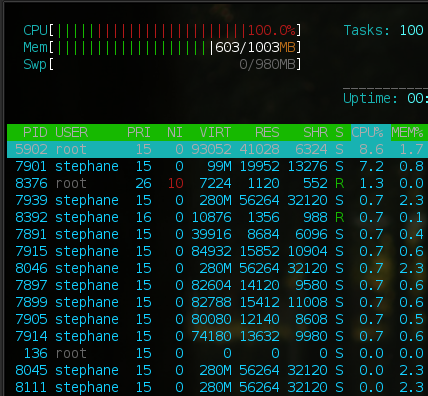
Sometimes new software not only brings unneeded features, but also a better usability... htop for example. Since I have it I don't use the old top anymore. But something is still surprising me... How can I have a total CPU use of 100% when the single tasks added make only 8.6 + 7.2 + 1.3 + (9*0.7) = 23.4
Where are the remaining 76.6% ?
Friday, September 08, 2006
Sunday, September 03, 2006
Studiengebuehr in England
... Wahrscheinlich geht es doch nicht so gut dort, laut der Spiegel. Wir wissen schon, dass genau das gleich in Deutschland passieren wird. Mir sollte es egal sein, weil ich nicht mehr Student bin. Aber irgendwie denke ich, dass man keine erfolgreiches Wirtschaft heutzutage mit Dummkopfe baut. Ist nur meine Meinung.
Thursday, August 24, 2006
Le desastre des medias
Quand je vois la television ces jours je suis vraiment vraiment amer.
Rien que des images de guerres entre bateaux a marseille, du cinema hollywoodien quoi. Des gens qui se battent. Mais ou est donc le fond? Ou parle t-on des poissons? Qui s'interesse s'il y a encore des thons? Personne!
Riez les pecheurs, vous allez bien rire dans 20 ans! Le probleme c'est que la terre entiere aura perdu.
Ou s'arretera donc la connerie humaine? Entre la tele imbecile, les pecheurs imbeciles et les telespectateurs imbeciles, Greenpeace represente vraiment une exception de conscience.
Rien que des images de guerres entre bateaux a marseille, du cinema hollywoodien quoi. Des gens qui se battent. Mais ou est donc le fond? Ou parle t-on des poissons? Qui s'interesse s'il y a encore des thons? Personne!
Riez les pecheurs, vous allez bien rire dans 20 ans! Le probleme c'est que la terre entiere aura perdu.
Ou s'arretera donc la connerie humaine? Entre la tele imbecile, les pecheurs imbeciles et les telespectateurs imbeciles, Greenpeace represente vraiment une exception de conscience.
La surpeche du thon
Je ne sais pas pourquoi, mais je pense que cet article est juste (Le Monde) . Si les scientifiques assurent que les thons sont tres menaces, pourquoi serait-ce faux? Qui peut prouver scientifiquement le contraire?
Ca me revolte complement de lire ca, mais que faire? Et qu'est ce que l'on va faire, une fois qu'il n'y aura plus de thon?
Ca me revolte complement de lire ca, mais que faire? Et qu'est ce que l'on va faire, une fois qu'il n'y aura plus de thon?
Sunday, August 20, 2006
John Grisham: The Street Lawyer
During these holidays, I finally took time to read. One of the books I read is The Street Lawyer from John Grisham, after an advice from a friend lawyer.
This is about a young successful lawyer of Washington D.C. - Michael Brock, already near to be a partner, is suddently taken in hostage by an homeless, and, searching for an explanation, comes to meet Mordecai Green, a lawyer for homeless. The 'Legal Clinic' of Washington D.C. really exists, actually. The more he learns about homeless peoples, Michael Brock decides to let his work in the big firm to become a lawyer for homeless people. To give a sense to his life.
What's good in this? What did I like especially in this book? Well it's difficult to say. Part of it has to do with the excellent style and writing skills of Grisham. He's really, really good. The surprising thing is that I didn't awaited such a critism of the american system and of capitalism.
There are some really big questions in this story. What are we making individually to help the poors? What are we doing to avoid that peoples come to live on the streets, and what are we making to bring them out of the streets?
Outside of showing the cliche that one can be happy with a minimum wage, the story shows the price to pay for financial wealth. And it's very expensive. The other part is about questioning, and accomplishment. How could I rebuild my life if I should start from zero again? What do I really want do in my life? Michael, by becoming a social lawyer not only rebuilds the life of poor people, he rebuilds his life, and that's one of the more interesting part of the book.
The homeless. They get almost no help from politicians, because they don't vote. Why caring about them? Grisham explains very well that an homeless is cheaper for the state and better for the society if he's in a shelter rather than in prison. And he's even more profitable to the society if he gets a job and a home! One can only think that we really live in a stupid world, where you need to lobby in order to obtain rights. But then, I should first ask myself what I'm doing to change this situation. Nothing.
Oh yeah, there is an intrigue in this book. With lawyers, conspiracies, etc. But this is not really the point. Actually, this is the least important part of the book.
I'm gonna read other books from Grisham, because he seems to be a really good writer.
And I'm gonna think about this book during some times. Or maybe reread it, it would be worth it.
This is about a young successful lawyer of Washington D.C. - Michael Brock, already near to be a partner, is suddently taken in hostage by an homeless, and, searching for an explanation, comes to meet Mordecai Green, a lawyer for homeless. The 'Legal Clinic' of Washington D.C. really exists, actually. The more he learns about homeless peoples, Michael Brock decides to let his work in the big firm to become a lawyer for homeless people. To give a sense to his life.
What's good in this? What did I like especially in this book? Well it's difficult to say. Part of it has to do with the excellent style and writing skills of Grisham. He's really, really good. The surprising thing is that I didn't awaited such a critism of the american system and of capitalism.
There are some really big questions in this story. What are we making individually to help the poors? What are we doing to avoid that peoples come to live on the streets, and what are we making to bring them out of the streets?
Outside of showing the cliche that one can be happy with a minimum wage, the story shows the price to pay for financial wealth. And it's very expensive. The other part is about questioning, and accomplishment. How could I rebuild my life if I should start from zero again? What do I really want do in my life? Michael, by becoming a social lawyer not only rebuilds the life of poor people, he rebuilds his life, and that's one of the more interesting part of the book.
The homeless. They get almost no help from politicians, because they don't vote. Why caring about them? Grisham explains very well that an homeless is cheaper for the state and better for the society if he's in a shelter rather than in prison. And he's even more profitable to the society if he gets a job and a home! One can only think that we really live in a stupid world, where you need to lobby in order to obtain rights. But then, I should first ask myself what I'm doing to change this situation. Nothing.
Oh yeah, there is an intrigue in this book. With lawyers, conspiracies, etc. But this is not really the point. Actually, this is the least important part of the book.
I'm gonna read other books from Grisham, because he seems to be a really good writer.
And I'm gonna think about this book during some times. Or maybe reread it, it would be worth it.
Wednesday, August 16, 2006
Blogger update
Saturday, August 05, 2006
How it looks like to flight a plane

Sorry, I couldn't resist... I'm a little bit frustrated that I didn't had a fish-eye lense to take this photo...
Hear airport towers on your computer
A flight instructor gave us a nice tip yesterday during the theory class:
Some big airports, like Chicago O'Hare or Boston, are streaming their radio frequency (ground, tower, approach/departure) on the net.
A good link is LiveATC.net
Enjoy! But solid knowledges in ATC and aviation are necessary. This is a very good site for "aviation enthusiasts, student pilots, student air traffic controllers, flight simulation enthusiasts, FBO operators, airline operators, and anyone with an interest in aviation communications. "
(LiveATC.net)
That said, for me, poor French, it's very difficult to understand... I'm curious to see what will happen when I'll have to land in Stuttgart (EDDS) !
Some big airports, like Chicago O'Hare or Boston, are streaming their radio frequency (ground, tower, approach/departure) on the net.
A good link is LiveATC.net
Enjoy! But solid knowledges in ATC and aviation are necessary. This is a very good site for "aviation enthusiasts, student pilots, student air traffic controllers, flight simulation enthusiasts, FBO operators, airline operators, and anyone with an interest in aviation communications. "
(LiveATC.net)
That said, for me, poor French, it's very difficult to understand... I'm curious to see what will happen when I'll have to land in Stuttgart (EDDS) !
Sunday, July 30, 2006
I am not worrying about my future as software engineer
When I see how much the processes are inefficient and wrong in most of the companies I have to deal with in my private life, I'm not worrying about my future as a software engineer.
Phone company: I move into a new apartment, they change my phone line to the new one, but the bills are still sent to my old address... This fucking phone company billed me 300 Euros for my move! And they believe I will buy any single service after that?
Electricity company: They sent the bill to the former lodger, and then wanted me to pay 4 times more than her. They simply didn't look at how much she was paying. I needed to phone them to get a more normal price.
The different train companies are completely unsynchronized together. There are tons of things to optimize, because most of them have no idea what IT can really bring. Most times IT projects are under-funded, under time pressure, and for a result have a poor quality that wouldn't be acceptable in any other industry.
If the computers stopped gaining any power tomorrow, I'm sure I would anyway be able to work until retirement, because there is still so much to do to polish all the bad softwares and IT processes... and yes, it's the case even in Germany! The regional trains are late 50% of the times and the big companies are completely disorganized... Let's stop this unsense!
Phone company: I move into a new apartment, they change my phone line to the new one, but the bills are still sent to my old address... This fucking phone company billed me 300 Euros for my move! And they believe I will buy any single service after that?
Electricity company: They sent the bill to the former lodger, and then wanted me to pay 4 times more than her. They simply didn't look at how much she was paying. I needed to phone them to get a more normal price.
The different train companies are completely unsynchronized together. There are tons of things to optimize, because most of them have no idea what IT can really bring. Most times IT projects are under-funded, under time pressure, and for a result have a poor quality that wouldn't be acceptable in any other industry.
If the computers stopped gaining any power tomorrow, I'm sure I would anyway be able to work until retirement, because there is still so much to do to polish all the bad softwares and IT processes... and yes, it's the case even in Germany! The regional trains are late 50% of the times and the big companies are completely disorganized... Let's stop this unsense!
Sunday, July 16, 2006
Mein 1. Flugstunde ist vorbei!
... gerade heute um 10 Uhr. Es war einfach super! Was fuer ein merkwuerdiges Eindrueck, auf der linke Sitz zu sein...
Wednesday, July 12, 2006
Saturday, July 08, 2006
A bug in a TFT screen
... Yes, a bug is in my screen! A real, living bug! I don't know when it will die, in the middle of my screen... shit!
Before there was the CRT screen. The real screen was an hermetic box without air, so nothing (and no bugs) could come in. But the TFT screens don't need anymore an empty and completely hermetic box. So a very little bug went under my screen. I can see it but I can't touch it. I even tried to kill it while it was under the border of the screen :( Now I have this little moving thing under my screen and it's gonna staying here. I can't remove it without opening my screen. Bad design - new technologies, new problems.
Before there was the CRT screen. The real screen was an hermetic box without air, so nothing (and no bugs) could come in. But the TFT screens don't need anymore an empty and completely hermetic box. So a very little bug went under my screen. I can see it but I can't touch it. I even tried to kill it while it was under the border of the screen :( Now I have this little moving thing under my screen and it's gonna staying here. I can't remove it without opening my screen. Bad design - new technologies, new problems.
Wednesday, July 05, 2006

Thursday, June 29, 2006
I want to go there again!
Sorry to post 2 times about the same topic, but I can't resist:
Venezia on Google Maps.
Anyway, try to find the runway on the photo... It's pretty detailled, but a little bit old...
Oh, and I found out that the restaurant where we ate was at the Grand Canal! I didn't even realized because it was so peaceful there...
Venezia on Google Maps.
Anyway, try to find the runway on the photo... It's pretty detailled, but a little bit old...
Oh, and I found out that the restaurant where we ate was at the Grand Canal! I didn't even realized because it was so peaceful there...
Sunday, June 25, 2006
Une impression d'irreel
Petit poste tres condense et un peu froid pour une experience unique que je ne suis pas pret d'oublier:
Hier l'aeroclub de Herrenberg a organise un vol pour Venise... Aller-retour en un jour, avec 2 heures et demi de vol dans chaque direction. Je me suis inscrit comme simple passager.

L'aller fut relativement tranquille, malgre une visibilite horizontale tres faible. Survol des alpes, passage a l'ouest d'Innsbruck. Les Alpes, spectacle incroyable depuis une altitude de 35oo metres environ...

Apres arrivee en Italie, direction Padova puis la lagune de Venezia. Absolument splendide. L'approche sur l'aerodrome du Lido nous fait passer vraiment pres de Venezia, c'est absolument incroyable comme spectacle!

Un membre de l'aeroclub de Venezia nous fait une petite visite guidee avec la place San-Marco puis le pont du Rialto...
Tres touristique mais 300 metres plus loin il nous emmene dans un restaurant totalement cache mais si sympathique et typique...

Tres bon repas, on repart pour le Lido et ne ratons pas l'occasion d'une baignade dans la mer Adriatique :)

Depart tout juste dans les temps, une fois en l'air nous avons des problemes avec un controlleur italien pas vraiment competent. On reste a 1000 pieds (300 metres) d'altitude pendant trop longtemps, ca va etre tres dur de grimper au dessus des montagnes. Juste au dernier moment nous obtenons autorisation de prendre de l'altitude. Malheureusement ca ne suffit pas et nous devons nous rabbattre sur une vallee.


Tout le long de ce chemin a travers les Alples nous restons sous les nuages en s'orientant suivant les reliefs et divers objets du sol. L'orage menace tout le long a notre droite, a gauche les montagnes sont trop hautes... Zigzag entre les montagnes jusqu'a Innsbruck. Les controlleurs autrichiens sont d'une competence et sympathie inimaginable, ils nous laissent survoler l'aeroport d'Innsbruck. Magnifique!
Prise d'altitude puis passage juste a cote du Zugspitze, puis arrivee sur l'Allemagne. Le soleil nous retrouve a ce moment avec un magnifique arc-en-ciel.

Retour calme a Poltringen vers 20:40.
Hier l'aeroclub de Herrenberg a organise un vol pour Venise... Aller-retour en un jour, avec 2 heures et demi de vol dans chaque direction. Je me suis inscrit comme simple passager.

L'aller fut relativement tranquille, malgre une visibilite horizontale tres faible. Survol des alpes, passage a l'ouest d'Innsbruck. Les Alpes, spectacle incroyable depuis une altitude de 35oo metres environ...
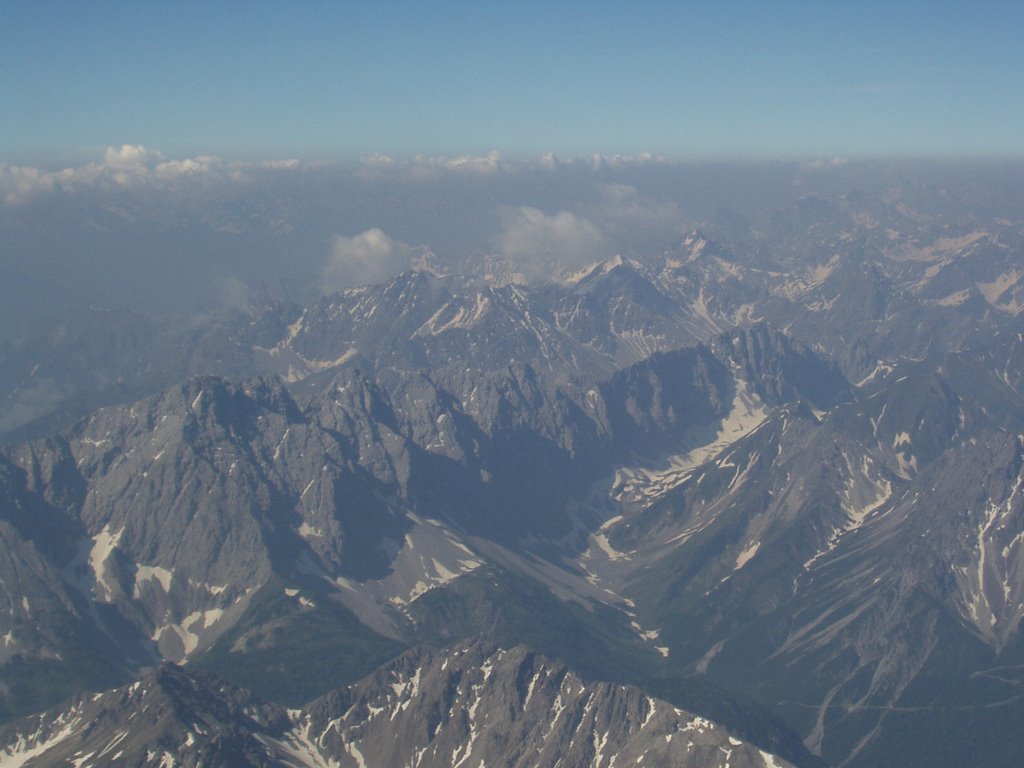

Apres arrivee en Italie, direction Padova puis la lagune de Venezia. Absolument splendide. L'approche sur l'aerodrome du Lido nous fait passer vraiment pres de Venezia, c'est absolument incroyable comme spectacle!
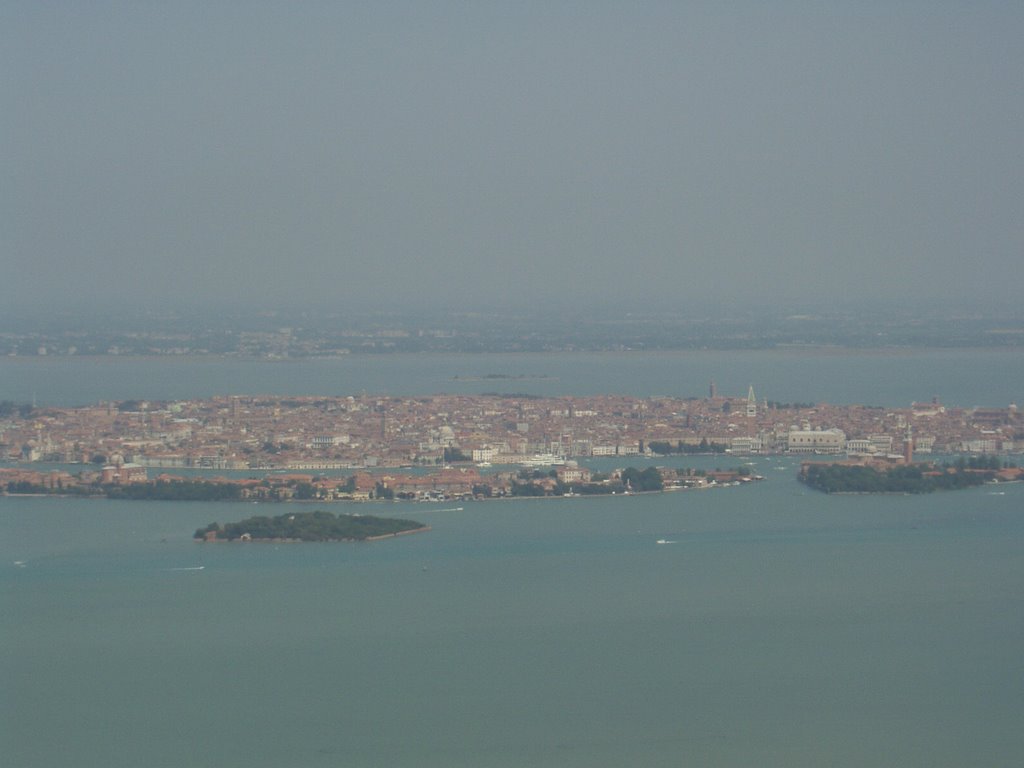
Un membre de l'aeroclub de Venezia nous fait une petite visite guidee avec la place San-Marco puis le pont du Rialto...
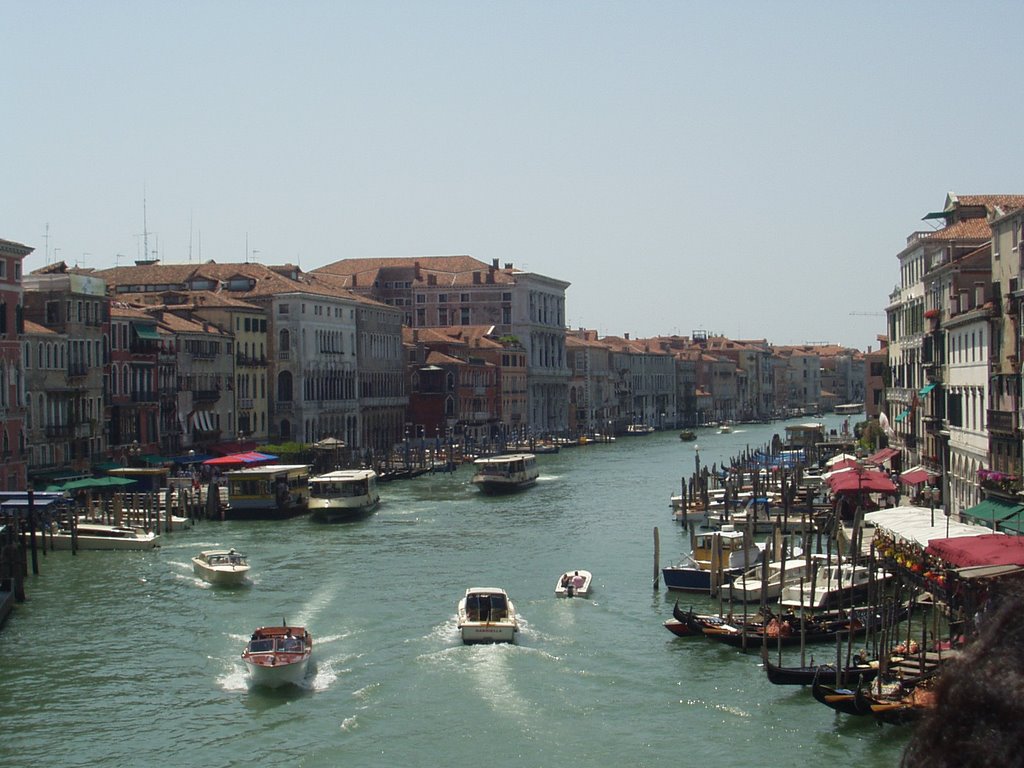
Tres touristique mais 300 metres plus loin il nous emmene dans un restaurant totalement cache mais si sympathique et typique...

Tres bon repas, on repart pour le Lido et ne ratons pas l'occasion d'une baignade dans la mer Adriatique :)
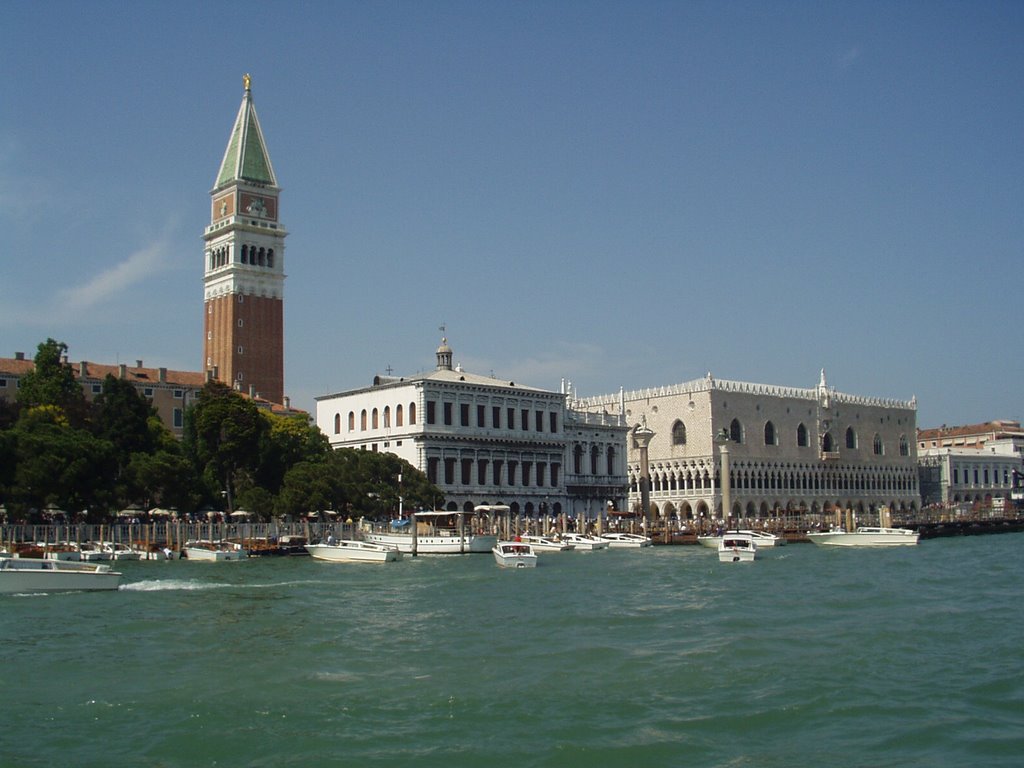
Depart tout juste dans les temps, une fois en l'air nous avons des problemes avec un controlleur italien pas vraiment competent. On reste a 1000 pieds (300 metres) d'altitude pendant trop longtemps, ca va etre tres dur de grimper au dessus des montagnes. Juste au dernier moment nous obtenons autorisation de prendre de l'altitude. Malheureusement ca ne suffit pas et nous devons nous rabbattre sur une vallee.


Tout le long de ce chemin a travers les Alples nous restons sous les nuages en s'orientant suivant les reliefs et divers objets du sol. L'orage menace tout le long a notre droite, a gauche les montagnes sont trop hautes... Zigzag entre les montagnes jusqu'a Innsbruck. Les controlleurs autrichiens sont d'une competence et sympathie inimaginable, ils nous laissent survoler l'aeroport d'Innsbruck. Magnifique!
Prise d'altitude puis passage juste a cote du Zugspitze, puis arrivee sur l'Allemagne. Le soleil nous retrouve a ce moment avec un magnifique arc-en-ciel.
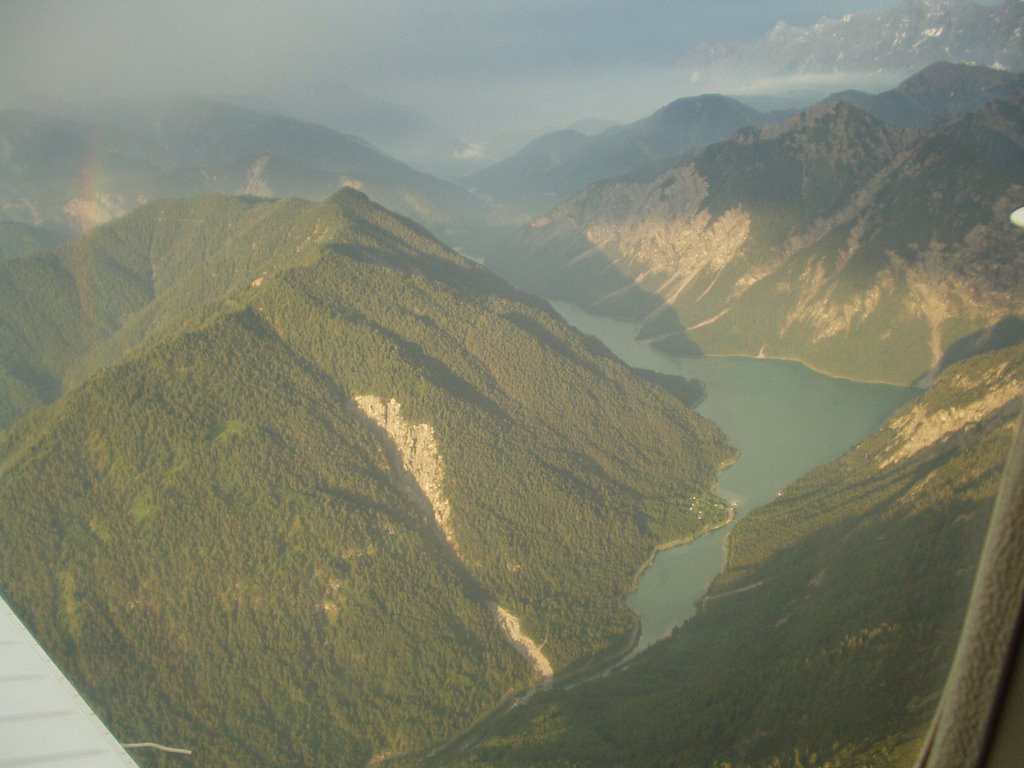
Retour calme a Poltringen vers 20:40.
Saturday, June 03, 2006
Silence
J'aime mon nouvel appartement : en une nuit, je n'ai entendu que le bruit des cloches de l'église. Autant dire que j'ai dormi comme je ne l'avais pas fait depuis longtemps !
Saturday, May 20, 2006
The Simpsons revisited
The Simpsons with real-life actors. Funny video on Google Video. And if you look at the right sidebar, you surely will understand how I found this video...
Thursday, May 18, 2006

Wednesday, May 03, 2006
The 10 Worst Corporations of 2005
If half of that is true, then no surprise that a lot of peoples hate capitalism...
Monday, May 01, 2006
The exterminators, or how to build good software
The IEEE Spectrum is really a high-level magazine about technology. And has very interesting articles.
This one, subject of a Slashdot story: An English company that make software with very few bugs. For critical-purposes sofware. When you build a sofware to make big money-transactions, control a plane or a power plant, you simply can't make errors.
The methods explained in the article are sure valuable and usable for every project, including open-source; and although the programming language specified (Spark) is commercial, there are a lot of open-source alternatives. Like Eiffel (smarteiffel as GNU project), or OCaml. Some formal checkers are available too.
This one, subject of a Slashdot story: An English company that make software with very few bugs. For critical-purposes sofware. When you build a sofware to make big money-transactions, control a plane or a power plant, you simply can't make errors.
The methods explained in the article are sure valuable and usable for every project, including open-source; and although the programming language specified (Spark) is commercial, there are a lot of open-source alternatives. Like Eiffel (smarteiffel as GNU project), or OCaml. Some formal checkers are available too.
Another cool software...
... that it's not possible to compile without messing up my system with tons of externs library. Maybe that's good that I don't spend time on such games.
Dan Simmons about good writing
Dan Simmons explains in this essay a few rules (first defined by Mark Twain) of good writing, and why professional writing is hard.


Wednesday, April 26, 2006
The next green revolution
A nice article on wired, or why environmentalism can/has to be oriented forward, and should not reject progress. No real new thing in this article, but a good introduction for curious people.
The blog given as link is very interesting too.
The blog given as link is very interesting too.
Tuesday, April 25, 2006
Schlechte Architektur
Der Architekt, der unser Wohnheim kreiert hat, hat sicherlich nie in einer WG gewohnt. So bloed soll man sein, um die Kueche direkt neben die Zimmern zu bauen.
Thursday, April 20, 2006
Searching for an interesting job?
Trolltech is searching for developers for their new office in Berlin!
Tuesday, April 18, 2006
Private Joke (fr)
Vous la connaissez probablement:
Heisenberg se fit un jour arrêter pour excès de vitesse. Le policier, effaré, lui crie :
— Mais vous êtes fou, savez vous à quelle vitesse vous rouliez ?
Et Heisenberg de répondre :
— Non, mais je sais très bien où je suis.
Heisenberg se fit un jour arrêter pour excès de vitesse. Le policier, effaré, lui crie :
— Mais vous êtes fou, savez vous à quelle vitesse vous rouliez ?
Et Heisenberg de répondre :
— Non, mais je sais très bien où je suis.
Prof. Klaeren bei Osiander
Prof. Klaeren macht ein Vortrag in Osiander am 26.04 (Beschreibung), wegen seinem neuen Buch,Viren, Würmer und Trojaner - Streifzüge durch die Computerwelt.
Wer kommt mit?
Wer kommt mit?
This software looks so good
but it's f... hard to get it working!
MythTV
Really, it's only pain. After more than 8 hours I don't want to install a media center anymore. And like a lot of people, I wish to find a computer that is usable. A computer that wouldn't lose my time. I will buy an Apple as soon as I can, I believe.
I just feel like this woman (dilbert.com)
Ganymede, I should do like you and stay away from tv.
MythTV
Really, it's only pain. After more than 8 hours I don't want to install a media center anymore. And like a lot of people, I wish to find a computer that is usable. A computer that wouldn't lose my time. I will buy an Apple as soon as I can, I believe.
I just feel like this woman (dilbert.com)
Ganymede, I should do like you and stay away from tv.
Monday, April 17, 2006
Revolutionary motor?
Found this site: Angel Labs via Gizmodo (german).
It looks cool. Is it really secure, efficient and cheap? I don't have any clue. But I just think it's good to spread the information through the Web, so that as much people as possible know about this project. This time nobody will be able to say 'the oil industry killed it'...
It looks cool. Is it really secure, efficient and cheap? I don't have any clue. But I just think it's good to spread the information through the Web, so that as much people as possible know about this project. This time nobody will be able to say 'the oil industry killed it'...
Sunday, April 16, 2006
Kosmische Strahlung und Flugzeuge
Andi hat mir gestern ueber kosmische Strahlung gesprochen. Das kannte ich gar nicht, und habe dann versucht, ein bisschen mehr zu wissen. Da habe ich ein Dokument von British Airways gefunden.
Quotes aus diesem Dokument:
"Bei einer Gesamtdosis von 5 mSv pro Jahr über einen Zeitraum von 20 Jahren (d.h. mehr als die geschätzte Jahresstrahlung, der das Personal auf Langstreckenflügen ausgesetzt ist) liegt die Wahrscheinlichkeit einer Krebsentwicklung aufgrund von Strahlung bei 0,4%. Da laut Statistik rund 23% der Bevölkerung an einer Form von Krebs stirbt, steigt das Risiko aufgrund dieser zusätzlichen Strahlungsbelastung damit von 23% auf 23,4%."
"Die Ergebnisse zeigten eine höhere Lebenserwartung zwischen drei und fünf Jahren bei Piloten und Luftfahrtingenieuren im Vergleich zur allgemeinen Bevölkerung. Die Todesfälle aufgrund von Herzkrankheiten und allen Krebsarten liegen beim Flugpersonal deutlich niedriger als bei der Bevölkerung von England und Wales zusammmen."
Quotes aus diesem Dokument:
"Bei einer Gesamtdosis von 5 mSv pro Jahr über einen Zeitraum von 20 Jahren (d.h. mehr als die geschätzte Jahresstrahlung, der das Personal auf Langstreckenflügen ausgesetzt ist) liegt die Wahrscheinlichkeit einer Krebsentwicklung aufgrund von Strahlung bei 0,4%. Da laut Statistik rund 23% der Bevölkerung an einer Form von Krebs stirbt, steigt das Risiko aufgrund dieser zusätzlichen Strahlungsbelastung damit von 23% auf 23,4%."
"Die Ergebnisse zeigten eine höhere Lebenserwartung zwischen drei und fünf Jahren bei Piloten und Luftfahrtingenieuren im Vergleich zur allgemeinen Bevölkerung. Die Todesfälle aufgrund von Herzkrankheiten und allen Krebsarten liegen beim Flugpersonal deutlich niedriger als bei der Bevölkerung von England und Wales zusammmen."
Sehr gute Einfuehrung in Computer Linguistik und automatische Uebersetzung
Verloren in Uebersetzung (die Zeit). Das erklaert, was automatische Uerbersetzung ist, warum es noch nicht funktionniert, wie man es wollte, und warum es sich doch in die gute Richtung entwickelt. Eine interessante Beschreibung von dem 'state of the art'. Sowas lernt man eigentlich, wenn man computer linguistics studiert. Dieses Artikel ist echt interessant, eklaert ganz viel und ist wirklich von einem sehr hohen Niveau. Sowas kann man fast nie in Franzoesische Zeitungen lesen, glaube ich.
You are an animated designer
Friday, April 14, 2006
Empêchez la fermeture du consulat de France à Stuttgart
... Signez cette pétition. Un texte explique aussi pourquoi signer cette pétition. La fermeture du consulat aurait avant tout des répercutions négatives tant au niveau politique qu'économique. Tout ceci pour de petites économies au Ministère des Affaires Etrangères. Quand on voit le niveau de vie de l'Elysée...
The B-25 that crashed into the Empire State Building
This really happened in 1945, thus this was in this tragic time only a 'minor' event which few people knew about.
Saturday, April 08, 2006
French peoples should read this
This is soooo true. Most people in France don't have any clue about economics; maybe the only economists they know are Keynes and Marx. You don't get that far with that...
I especially like what this teacher says after her internship at Danone ! She suddently discovers that companies are not monsters and that a lot of people actually like working there! I know most state jobs are very frustrating, but then people believe it must be even worse in companies; especially students because they've never seen something else.
My parents are a good example: My father works for a company, my mother for the state. And both admit, it looks much better in the company.
Anyway, I'm not that negative because the opinions of the French toward liberal economy is changing very fast by now. At least that's my impression.
I especially like what this teacher says after her internship at Danone ! She suddently discovers that companies are not monsters and that a lot of people actually like working there! I know most state jobs are very frustrating, but then people believe it must be even worse in companies; especially students because they've never seen something else.
My parents are a good example: My father works for a company, my mother for the state. And both admit, it looks much better in the company.
Anyway, I'm not that negative because the opinions of the French toward liberal economy is changing very fast by now. At least that's my impression.
Wednesday, April 05, 2006
How Bill Gates works
It's always difficult to know what really happens in the offices of most CEOs and executives.
One of the most famous and richest of them, Bill Gates, explains himself his workflow in a very good article of CNN. Like him or not, he will stay one of the most influent persons in the computer world. And my opinion is, it's always better to read little concise texts from peoples that really succeeded at what they done instead of whole books from 'specialists' who've only done consulting and writing...
One of the most famous and richest of them, Bill Gates, explains himself his workflow in a very good article of CNN. Like him or not, he will stay one of the most influent persons in the computer world. And my opinion is, it's always better to read little concise texts from peoples that really succeeded at what they done instead of whole books from 'specialists' who've only done consulting and writing...
Sunday, April 02, 2006
Saturday, April 01, 2006
Subscribe to:
Posts (Atom)